Reactjs Developer salaries in India (Updated 2026)
Skills IT Academy Content Team
October 12, 2026
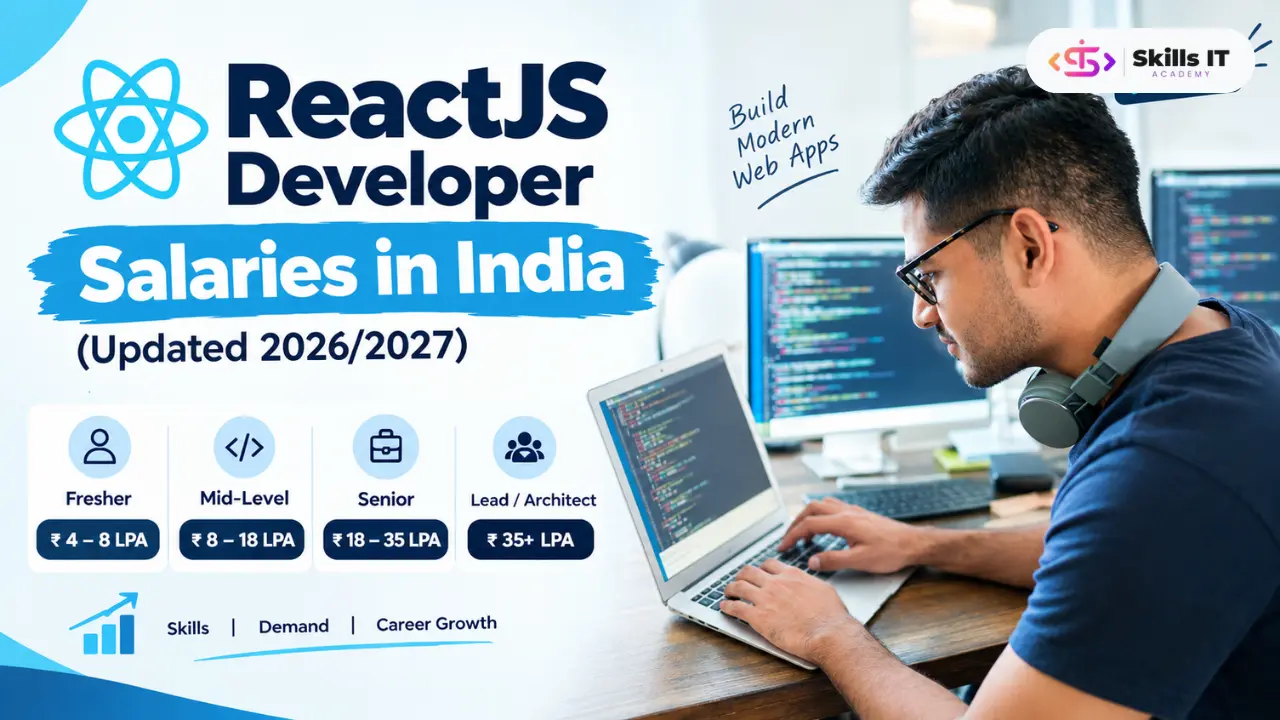
React.js development has become an important career path for aspiring frontend developers and software engineers in India. Businesses use React to build interactive websites, web applications, dashboards, e-commerce platforms, and modern user interfaces. As companies continue to invest in digital products, developers with strong JavaScript, React.js, and frontend engineering skills can explore opportunities across IT services, startups, product companies, and technology consulting.
One of the most common questions among students and job seekers is, "What is the React.js developer salary in India in 2026? "
The answer depends on experience, technical skills, location, company type, project experience, and the complexity of the role. Freshers typically start with lower packages, while developers who can build scalable applications, optimize performance, integrate APIs, and work effectively with modern frontend tools may qualify for higher-paying positions.
This article explains React.js developer salaries in India in 2026, fresher salary expectations, experience-wise salary ranges, Pune salary trends, essential technical skills, AI's impact on frontend development, job opportunities, and practical career preparation.
Quick Answer: What Is the React.js Developer's Salary in India in 2026?
According to Glassdoor's India salary data, React.js developers have an average base salary of approximately ₹5 lakh per year, with a typical base-pay range of ₹3 lakh to ₹7 lakh per year. Average additional pay is reported at approximately ₹28,000 per year. These figures are based on the salary information available on its salary page and may change as new data is submitted.
For junior React.js developers, Glassdoor reports an average base salary of approximately ₹3 lakh per year, with a typical range of ₹2 lakh to ₹5 lakh.
Actual offers can be lower or higher depending on the employer, location, experience, and technical interview performance.
Average React.js Developer Salary in India
The React.js developer salary in India varies because employers hire for different levels of responsibility. Some positions focus on developing individual interface components, while others require frontend architecture, testing, performance optimization, accessibility, and collaboration with backend teams.
The following figures provide a useful salary benchmark for candidates researching the market.
React.js Developer Salary Overview
- Average base salary: Approximately ₹5 lakh per year.
- Typical base-pay range: ₹3 lakh to ₹7 lakh per year.
- Average additional pay: Approximately ₹28,000 per year, according to Glassdoor's reported figures.
- Junior React.js developer average base salary: Approximately ₹3 lakh per year.
These are reported salary benchmarks, not guaranteed salaries or fixed compensation limits. The amount offered to an individual candidate may differ considerably.
What Is the Difference Between Base Salary and CTC?
When comparing React.js developer jobs, candidates should understand the difference between base salary and cost to company (CTC).
Base salary is the fixed component of compensation before applicable deductions. CTC may include employer contributions, insurance, bonuses, variable pay, and other benefits.
For example, two employers may advertise the same annual CTC but offer different monthly fixed salaries. Candidates should compare the fixed component, variable component, benefits, and applicable deductions before accepting an offer.
React.js Developer Salary in India by Experience
Experience is one of the major factors affecting a React.js developer's salary. However, employers also evaluate coding ability, project quality, problem-solving, and the candidate's ability to work with production applications.
The following table presents indicative career-planning ranges, rather than a directly published salary survey for every experience level.
Experience: Indicative annual salary for intern or trainee: ₹1.5 lakh to ₹3 lakh Fresher, 0–1 year: ₹2.5 lakh to ₹5 lakh; Junior developer, 1–3 years: ₹3 lakh to ₹7 lakh Mid-level developer, 3–5 years: ₹6 lakh to ₹12 lakh Experienced developer, 5–8 years, ₹10 lakh to ₹18 lakh Senior developer, 8+ years, ₹15 lakh to ₹25 lakh or more
These ranges overlap because years of experience alone do not determine compensation. A developer with three years of strong React.js and TypeScript experience may earn more than someone with five years of experience primarily working on basic interface changes.
Specialist frontend engineers and engineering leads may earn more than these indicative ranges, depending on their responsibilities and employer.
React.js Developer Salary for Freshers
Freshers entering frontend development can use ₹2.5 lakh to ₹5 lakh per year as an indicative starting range for planning their job search. Some employers may offer lower packages, while candidates with strong practical skills may qualify for better offers.
Freshers should focus on learning how to build complete applications rather than memorising React concepts.
Important skills include:
- HTML5 and CSS3.
- JavaScript fundamentals and ES6+.
- React components, props, state, and hooks.
- React Router and application navigation.
- API integration using fetch or Axios.
- Responsive web design.
- Git and GitHub.
- Debugging, testing, and deployment fundamentals.
A portfolio containing two or three well-built projects can help demonstrate these skills to recruiters.
React.js Developer Salary for 1–3 Years of Experience
Developers with one to three years of experience may be able to move into more independent frontend responsibilities. They may work on API integrations, reusable components, application state, performance improvements, and production bug fixes.
Developers in this category can strengthen their profiles by learning TypeScript, testing tools, accessibility practices, and modern application architecture.
React.js Developer Salary for 3–5 Years of Experience
Mid-level developers are often expected to do more than implement designs. Employers may expect them to make technical decisions, review code, improve performance, maintain frontend architecture, and collaborate with designers and backend engineers.
Experience with complex applications, reusable design systems, testing strategies, and production debugging can support career growth.
React.js Developer Salary for Senior Professionals
Senior frontend developers may be responsible for architecture, mentoring, technical reviews, application reliability, and engineering standards.
Knowledge of TypeScript, performance profiling, automated testing, security considerations, and deployment workflows can be valuable for senior roles. Leadership responsibilities and experience delivering large applications may also influence compensation.
React.js Developer Salary in Pune in 2026
Pune is an important technology market for frontend developers, with opportunities across IT services, software product development, consulting, startups, and digital businesses.
According to Glassdoor's Pune salary page, React.js developers have an average base salary of approximately ₹5 lakh per year, with a typical base-pay range of ₹4 lakh to ₹9 lakh per year. The page reports average additional pay of approximately ₹22,000 per year.
A broader React Developer salary page for Pune reports an average base salary of around ₹6 lakh per year, with a typical range of ₹4 lakh to ₹10 lakh. Differences between the figures can arise from job-title definitions, sample sizes, and the underlying salary data.
Expected React.js Developer Salary Ranges in Pune
The following figures are indicative estimates for comparing opportunities in Pune, not verified averages for each experience category.
Experience Indicative Annual Salary: Freshers ₹2.5 lakh to ₹5 lakh, 1–3 years ₹3.5 lakh to ₹7 lakh, 3–5 years ₹6 lakh to ₹12 lakh, 5–8 years ₹10 lakh to ₹18 lakh, and senior or specialist ₹15 lakh to ₹25 lakh or more.
Actual salaries depend on the employer, job requirements, technical expertise, and interview performance.
What Influences React.js Developer Salaries in Pune?
Company type: Product companies, IT service providers, startups, and consulting firms may have different compensation structures.
Technical skills: JavaScript, TypeScript, React.js, API integration, testing, and frontend performance optimization can improve eligibility for specialized positions.
Project experience: Developers who can explain how they built, tested, and maintained complete applications may demonstrate stronger practical ability.
Communication and teamwork: Frontend developers regularly collaborate with UI/UX designers, backend developers, product managers, and quality assurance teams.
Location and work arrangement: Employer location, remote-work policies, and the availability of specialized roles can affect the opportunities available to candidates.
How Can Freshers in Pune Prepare for React.js Developer Jobs?
Candidates should build a structured learning plan covering frontend fundamentals, React.js, Git, APIs, responsive design, and project development.
Students comparing a software training institute in Pune should check whether the curriculum includes practical assignments, real-world projects, code reviews, interview preparation, and deployment experience.
Skills IT Academy can be considered as one option when researching IT training in Pune. Before enrolling in any program, candidates should verify the current syllabus, trainer experience, fees, project work, and placement-support terms. No training program can guarantee a particular salary or job offer.
Skills Required to Earn a Better React.js Developer Salary in 2026
React.js is a JavaScript library, but professional frontend development requires a broader set of skills. Employers look for developers who can create accessible, reliable, responsive, and maintainable applications.
1. HTML and CSS
HTML provides the structure of a webpage, while CSS controls its presentation and layout. Developers should understand semantic HTML, Flexbox, Grid, responsive design, and reusable styling patterns.
Accessibility is also important. Interfaces should support keyboard navigation, meaningful labels, readable contrast, and appropriate semantic elements.
2. JavaScript and ES6+
JavaScript is essential for React development. Candidates should understand variables, functions, arrays, objects, promises, asynchronous programming, modules, closures, and array methods.
Strong JavaScript fundamentals make it easier to understand React hooks, application state, API requests, and debugging.
3. React.js Fundamentals
Developers should understand:
- Components and JSX.
- Props and state.
- Functional components and hooks.
- Conditional rendering.
- Lists and keys.
- Event handling.
- Forms and validation.
- Component composition.
- Context and state-management concepts.
Candidates should also understand why components re-render and how to avoid unnecessary complexity in application state.
4. API Integration
Modern applications frequently retrieve and submit data through APIs. Developers should understand HTTP requests, JSON, loading states, error handling, authentication basics, and asynchronous operations.
A useful portfolio project should demonstrate how the application behaves when an API request fails, returns no results, or takes longer than expected.
5. TypeScript
TypeScript adds static typing to JavaScript and can help teams maintain larger applications. Developers should learn interfaces, types, unions, generics, and typing for React props and hooks.
TypeScript is not mandatory for every junior role, but it can be valuable for positions involving larger codebases.
6. Git and GitHub
Version control is a standard part of collaborative software development. Candidates should know how to create branches, commit changes, resolve basic merge conflicts, and use pull requests.
A well-organized GitHub portfolio can help recruiters review a candidate's code and project documentation.
7. Testing and Debugging
Professional frontend development includes finding and preventing bugs. Candidates should become familiar with browser developer tools, React Developer Tools, unit testing, component testing, and end-to-end testing concepts.
Testing knowledge can help developers deliver more reliable applications and collaborate effectively with quality assurance teams.
8. Performance Optimization
Developers should understand how to identify slow renders, reduce unnecessary work, optimize assets, and improve application loading performance.
Knowledge of lazy loading, code splitting, browser rendering, and performance measurement can be useful for larger projects.
9. Next.js and Modern Frontend Architecture
Some employers seek developers who understand server-side rendering, static rendering, routing, and full-stack web application concepts. Next.js can be useful for these positions.
However, candidates should first learn React fundamentals before trying to master multiple frameworks at the same time.
Is React.js Still a Good Career Choice in 2026?
React.js remains a relevant technology for building interactive web applications. It is used in many frontend projects, and developers can find roles that combine React with JavaScript, TypeScript, APIs, testing, and modern web development practices.
However, learning React.js alone does not guarantee employment. Employers typically assess a candidate's ability to build usable applications, understand browser behavior, solve problems, work with APIs, and maintain code.
Candidates should review current job descriptions and compare the skills requested by employers before choosing their learning path.
React.js Developer vs. Frontend Developer
The terms overlap, but they are not always interchangeable.
A React.js developer generally focuses on applications built with React. A frontend developer may work with React, Angular, Vue, or other technologies and may be responsible for broader browser, accessibility, performance, and design-system concerns.
Developers who combine React expertise with strong frontend fundamentals can apply to a wider range of suitable positions.
Will AI Replace React.js Developers?
AI tools are changing how developers write, test, and debug code. They can generate component templates, suggest CSS, explain errors, and help developers understand unfamiliar code.
However, building a production-ready application requires more than generating code. Developers must understand product requirements, application architecture, data flows, security, accessibility, performance, and user experience.
AI can produce code that is incomplete, inefficient, or incorrect. Developers remain responsible for testing and validating the output.
How React.js Developers Can Use AI Effectively
Developers can use AI tools to:
- Generate initial component structures.
- Explain unfamiliar JavaScript concepts.
- Suggest approaches to debugging.
- Draft unit tests.
- Identify possible performance improvements.
- Explore alternative implementation strategies.
These suggestions should always be reviewed and tested before being used in a production application.
Skills That Can Help Developers Stay Competitive
To remain competitive, React.js developers should combine technical fundamentals with practical engineering skills.
Focus on JavaScript, TypeScript, React architecture, testing, accessibility, API integration, performance optimization, and clear communication. Learn to evaluate AI-generated code instead of depending on it without understanding.
The long-term value of a developer comes from solving problems reliably, not simply writing code quickly.
Job Opportunities After Learning React.js
React.js skills can support several career paths in web development.
React.js Developer
Builds interactive interfaces, reusable components, and web application features using React.
Frontend Developer
Develops the browser-facing parts of websites and applications, including responsive layouts, accessibility, API integration, and performance.
UI Developer
Translates UI/UX designs into functional interfaces using HTML, CSS, JavaScript, and relevant frontend frameworks.
Full Stack Developer
Works across frontend and backend systems. React may be combined with Node.js, Express, databases, APIs, and authentication systems.
Next.js Developer
Builds React-based applications using Next.js and relevant rendering, routing, and application architecture features.
React Native Developer
Uses React Native to build mobile applications. Although React concepts are transferable, React Native is a separate technology with platform-specific development requirements.
Candidates should compare job descriptions carefully because each role has different expectations. A React.js course may provide a foundation, but some positions require additional technologies and experience.
How to Prepare for a React.js Developer Job in 2026
A structured learning plan can help freshers develop practical skills and prepare for technical interviews.
Step 1: Learn HTML, CSS, and JavaScript
Start with semantic HTML, responsive CSS, JavaScript fundamentals, asynchronous programming, and browser developer tools.
Build simple webpages before moving to complex React applications.
Step 2: Learn React.js Properly
Practise components, props, state, hooks, routing, forms, and API integration. Understand how components work together rather than copying code from tutorials.
Step 3: Build Practical Projects
Create projects that demonstrate different aspects of frontend development. Suitable examples include:
- A responsive e-commerce interface with product filtering and a shopping cart.
- A task management application with forms and persistent data.
- A dashboard that retrieves data from an API and displays charts.
- A job portal interface with search, filtering, and pagination.
Projects should include clear instructions, screenshots, a working deployment where possible, and an explanation of the technical decisions made.
Step 4: Learn Git, TypeScript, and Testing
Use Git for version control, introduce TypeScript where appropriate, and practice testing important user interactions.
These skills can help demonstrate readiness for collaborative development work.
Step 5: Prepare for Technical Interviews
Revise JavaScript, React hooks, state management, component lifecycle concepts, API integration, CSS layouts, and basic problem-solving.
Practise explaining your own projects, including the challenges you faced and how you solved them.
Step 6: Create a Portfolio and Apply for Jobs
Organize your projects on GitHub, prepare a concise resume, and apply for suitable internships, trainee positions, and junior frontend developer roles.
Track applications and improve your skills based on interview feedback.
A Practical Six-Month React.js Learning Roadmap
A six-month plan can provide structure for learners starting with limited frontend experience. The timeline should be adjusted according to prior knowledge and available study time.
Month 1: HTML, CSS, and JavaScript
Learn web fundamentals, responsive design, JavaScript syntax, functions, arrays, objects, and asynchronous programming.
Month 2: Advanced JavaScript and Git
Practise ES6+, promises, modules, browser debugging, Git, and GitHub.
Month 3: React.js Fundamentals
Learn components, props, state, hooks, forms, and routing. Build small interactive applications.
Month 4: APIs and Application Development
Build projects involving API integration, error handling, loading states, authentication concepts, and application state.
Month 5: TypeScript, Testing, and Portfolio Projects
Practise TypeScript, component testing, debugging, performance basics, and complete at least one substantial project.
Month 6: Interview Preparation and Job Applications
Revise technical concepts, practice coding questions, improve your resume, prepare project explanations, and apply for relevant positions.
This roadmap is a learning guide, not a promise of employment within six months. Job readiness depends on practice, prior experience, project quality, and interview performance.
Frequently Asked Questions About React.js Developer Salary in India
1. What is the average React.js developer salary in India in 2026?
Glassdoor reports an average base salary of approximately ₹5 lakh per year for React.js developers in India, with a typical base-pay range of ₹3 lakh to ₹7 lakh. Actual compensation varies by employer, experience, and location.
2. What is the starting salary of a fresher React.js developer in India?
An indicative planning range is ₹2.5 lakh to ₹5 lakh per year. Actual offers may be lower or higher depending on the employer, the candidate's skills, and the role.
3. Can a fresher earn ₹6 LPA as a React.js developer?
Yes, some freshers may receive offers at this level. Strong JavaScript fundamentals, React.js knowledge, practical projects, communication skills, and interview performance may help. However, ₹6 LPA is not a guaranteed or standard starting package.
4. What is the React.js developer salary in Pune?
Glassdoor reports an average base salary of approximately ₹5 lakh per year for React.js developers in Pune, with a typical range of ₹4 lakh to ₹9 lakh. Broader React Developer data reports an average of approximately ₹6 lakh, illustrating how figures vary by job-title definition and dataset.
5. What is the salary of a React.js developer with three years of experience?
A broad indicative planning range is ₹5 lakh to ₹10 lakh per year, although actual compensation can fall outside this range. Technical expertise, employer type, and project responsibilities influence the offer.
6. Which skills are required for a high-paying React.js developer job?
Strong JavaScript, React.js, TypeScript, API integration, testing, performance optimization, Git, and application architecture are useful. Some roles also require Next.js, accessibility expertise, or full-stack development skills.
7. Is React.js enough to get a software developer job?
React.js is a useful foundation, but employers usually expect HTML, CSS, JavaScript, Git, debugging, and practical project experience. Additional skills depend on the role.
8. Will AI reduce React.js developer jobs?
AI may automate some routine coding tasks, but developers are still needed to understand requirements, design systems, validate code, debug applications, and maintain production software. The overall impact will depend on how employers adopt AI tools.
9. Is React.js better than Angular for freshers?
Neither technology is universally better. React is a library with a flexible ecosystem, while Angular provides a more structured framework. Candidates should compare local job descriptions, their learning preferences, and the requirements of their target employers.
10. How long does it take to learn React? JS?
Candidates with solid JavaScript fundamentals may learn the core concepts in several weeks. Becoming comfortable with production-style applications, testing, debugging, and interview problems generally requires additional practice.
11. How can I choose a software training institute in Pune for React.js?
Review the syllabus, trainer experience, practical projects, JavaScript fundamentals, React hooks, API integration, Git, interview preparation, fees, and placement-support policies. Verify all claims before enrolling.
12. Does completing a React.js course guarantee a job?
No. A course can provide structured learning and practice, but employment depends on technical ability, project experience, communication, interviews, and the availability of suitable positions.
Conclusion: Build Practical Skills to Improve Your React.js Career Prospects
React.js development offers a pathway into frontend engineering, UI development, full-stack development, and related software careers. Current salary benchmarks from Glassdoor place the average React.js developer base salary in India at approximately ₹5 lakh per year, although individual offers vary significantly.
For freshers, the most effective starting point is to master HTML, CSS, JavaScript, and React fundamentals before progressing to TypeScript, testing, API integration, and advanced application development. Candidates in Pune should research local opportunities and compare job requirements rather than relying on advertised salary promises.
Skills IT Academy can be considered by learners researching a software training institute in Pune. Before enrolling, verify the current curriculum, practical training, trainer experience, and placement-support terms.
Ultimately, a strong technical foundation, practical projects, consistent interview preparation, and the ability to solve real development problems can help candidates work towards their career goals in 2026 and beyond.