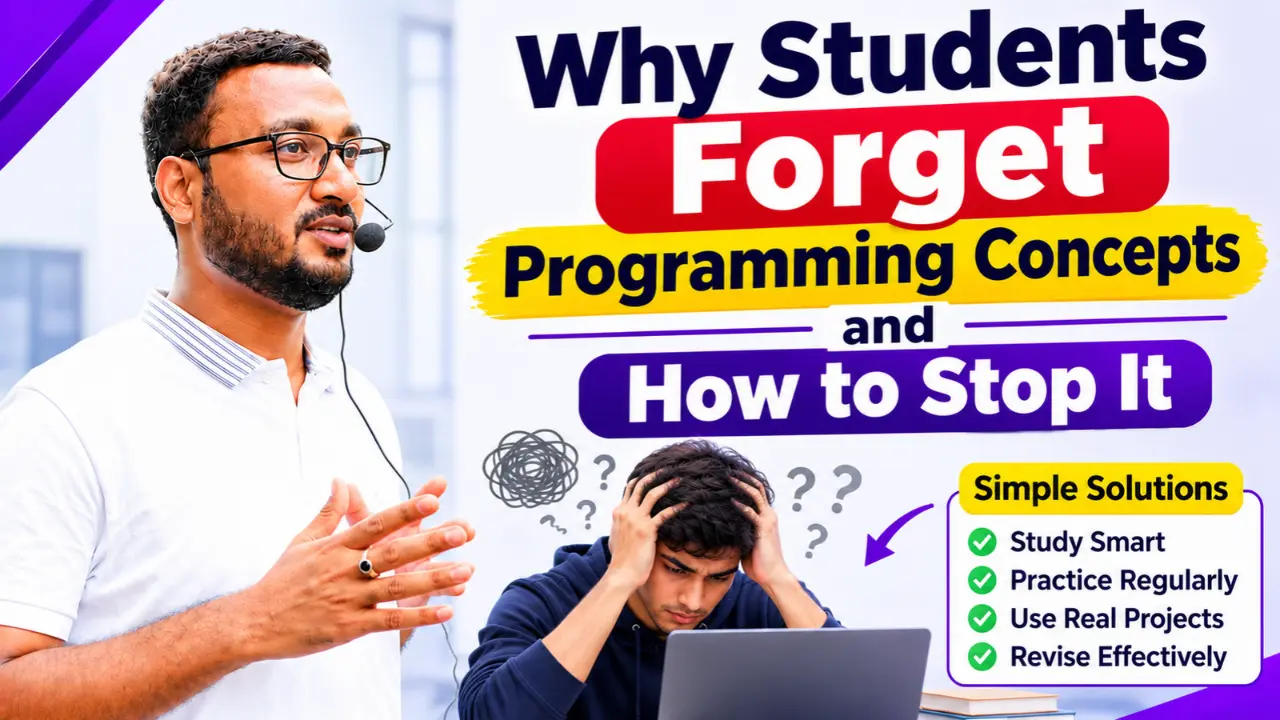
Why Students Forget Programming Concepts and How to Stop It
Skills IT Academy Content Team
November 28, 2026
Introduction
Learning programming is an important step towards building a successful career in the IT industry. Whether students are learning Java, Python, C, C++, JavaScript, or full-stack development, understanding programming concepts is essential for becoming a skilled software developer.
However, many students face a common problem during their programming journey: they understand a programming concept today but forget it after a few days or weeks.
For example, a student may understand loops during a programming class but struggle to write a loop independently when solving a practical problem. Similarly, students may learn object-oriented programming concepts such as inheritance, polymorphism, and encapsulation but find it difficult to apply them while developing applications.
This problem is common among beginners, college students, fresh graduates, and aspiring software developers.
The main reason is that programming is not just about understanding theory. It requires regular practice, logical thinking, problem-solving, and the ability to apply concepts in different situations.
Students who only watch tutorials, read notes, or memorize code examples may struggle to remember programming concepts for a long time.
The good news is that forgetting programming concepts can be reduced through effective learning strategies, consistent coding practice, revision, and practical project development.
In this article, we will explore why students forget programming concepts, the common mistakes that affect programming memory, and practical ways to improve coding knowledge and become more confident programmers.
Quick Answer: Why Do Students Forget Programming Concepts?
Students forget programming concepts mainly because of insufficient practice, lack of revision, passive learning, memorizing code without understanding logic, and not applying concepts to real-world projects.
The best way to remember programming concepts is to practice coding regularly, solve problems independently, revise previously learned topics, build small projects, and explain concepts in your words.
Consistent hands-on practice helps students develop stronger programming fundamentals and improve their problem-solving abilities.
1. Why Do Students Forget Programming Concepts?
Forgetting programming concepts is a common learning challenge. Understanding a topic once does not necessarily mean that a student can remember and apply it later.
Here are some important reasons behind this problem.
A. Learning Programming Through Theory Only
Many beginners spend more time reading programming notes and watching video tutorials than actually writing code.
Although theoretical knowledge is important, programming is a practical skill.
For example, reading about Java loops may help students understand how loops work, but writing different loop programs helps them remember the syntax and logic.
Without practical implementation, students may struggle to apply concepts independently.
B. Memorizing Code Instead of Understanding Logic
Some students memorize programming examples without understanding how the code works.
For example, they may remember a program for reversing a number but fail to write the same logic when asked to reverse a different type of input.
Programming requires logical thinking rather than memorization.
Students should understand:
- Why a particular statement is used.
- How variables store information.
- How conditions control program execution.
- How loops repeat instructions.
- How functions divide programs into smaller tasks.
Understanding the logic behind code makes programming concepts easier to remember.
C. Not Practicing Regularly
Programming requires consistency.
If students learn a topic today but do not practice it for several weeks, they may find it difficult to recall the syntax and implementation.
For example, students who learn arrays but rarely solve array-based problems may struggle when working with array manipulation later.
Regular coding practice helps strengthen understanding and improves recall.
D. Learning Too Many Concepts at Once
Beginners sometimes try to learn multiple programming topics within a short period.
They may study variables, loops, arrays, functions, object-oriented programming, exception handling, and database connectivity without spending enough time practicing each concept.
This can create confusion.
Students should follow a structured learning approach and build their knowledge gradually.
E. Not Connecting Concepts with Practical Examples
Programming concepts become easier to understand when students connect them with real-world situations.
For example:
- Variables can store student names and marks.
- Loops can process multiple employee records.
- Arrays can store product information.
- Classes and objects can represent real-world entities.
- SQL queries can retrieve customer information from databases.
Practical examples help students understand where and why programming concepts are used.
2. Common Programming Concepts That Students Frequently Forget
Some programming topics require regular revision because they involve syntax, logic, and practical implementation.
Here are common concepts that beginners may find difficult to remember.
A. Variables and Data Types
Students sometimes forget how to declare variables and select appropriate data types.
Important topics include:
- Integer data types.
- Floating-point data types.
- Character and string variables.
- Boolean values.
- Variable declaration and initialization.
- Type conversion.
Practicing small programs involving different data types helps students understand their usage.
B. Conditional Statements
Conditional statements help programs make decisions.
Students should regularly practice:
- if statements.
- if-else statements.
- else-if ladder.
- Nested if statements.
- switch statements.
For example, writing a program to check whether a student has passed or failed helps reinforce conditional logic.
C. Loops
Loops are important for executing repetitive operations.
Common loop concepts include:
- for loop.
- while loop.
- do-while loop.
- Nested loops.
- Break and continue statements.
Students should solve different problems involving number patterns, multiplication tables, factorials, and number operations.
D. Arrays and Strings
Arrays and strings are essential programming concepts.
Students should practice:
- Array declaration.
- Array initialization.
- Accessing array elements.
- Searching and sorting.
- String manipulation.
- Reversing strings.
- Finding duplicate elements.
Regular problem-solving improves confidence with these concepts.
E. Object-Oriented Programming
Object-oriented programming is an important concept in languages such as Java.
Students frequently struggle to remember the differences between:
- Classes and objects.
- Inheritance.
- Polymorphism.
- Encapsulation.
- Abstraction.
- Constructors.
- Method overloading and overriding.
Instead of memorizing definitions, students should create small programs that demonstrate each concept.
F. SQL and Database Concepts
Students learning backend development should also revise database concepts.
Important topics include:
- SELECT, INSERT, UPDATE, and DELETE.
- WHERE conditions.
- SQL joins.
- Primary keys and foreign keys.
- Database relationships.
- Aggregate functions.
- JDBC connectivity.
Building applications that connect programming languages with databases helps students remember these concepts.
3. How to Stop Forgetting Programming Concepts
The most effective way to remember programming concepts is to move from passive learning to active implementation.
Here are practical strategies students can follow.
A. Practice Coding Every Day
Daily coding practice is one of the best ways to improve programming knowledge.
Students do not need to spend several hours coding every day. Even 30 to 60 minutes of focused practice can help develop consistency.
For example:
- Monday: Variables and data types.
- Tuesday: Conditional statements.
- Wednesday: Loops.
- Thursday: Arrays and strings.
- Friday: Functions and methods.
- Saturday: Problem-solving exercises.
- Sunday: Revision and practice tests.
The objective should be consistent practice rather than completing many topics quickly.
B. Write Code Without Looking at Notes
After learning a programming concept, close your notes and try to write a program independently.
For example, after learning loops, try writing:
- A multiplication table program.
- A factorial program.
- A program to reverse a number.
- A program to find the sum of digits.
- A number pattern program.
If you cannot write the program immediately, revisit the concept and try again.
This approach helps improve independent problem-solving skills.
C. Follow the Revision Technique
Do not revise a programming topic only once.
Revisit previously learned concepts at increasing intervals.
A simple revision schedule could be:
- Day 1: Learn a new programming concept.
- Day 2: Practice the same concept.
- Day 4: Solve a few problems without notes.
- Day 7: Revise and write programs independently.
- Day 14: Apply the concept in a small project.
- Day 30: Test your understanding again.
This spaced revision approach helps students strengthen long-term recall.
D. Explain Programming Concepts in Your Own Words
One useful learning technique is to explain a programming concept as if you are teaching someone else.
For example, explain:
- What is a variable?
- Why do we use loops?
- What is inheritance in Java?
- How does an array work?
- What is the difference between a class and an object?
If you can explain a concept clearly and demonstrate it through code, you are more likely to understand it properly.
E. Solve Problems Without Immediately Checking Solutions
Many students look at solutions as soon as they encounter a difficult programming question.
Instead, spend some time understanding the problem and developing your own approach.
Follow these steps:
- Read the problem carefully.
- Identify the required input and output.
- Break the problem into smaller steps.
- Write the logic using pseudocode.
- Implement the solution.
- Test it using different inputs.
- Review the solution and identify improvements.
This approach develops logical thinking and independent coding ability.
4. Why Practical Programming Projects Help Students Remember Concepts
Building projects is one of the most effective ways to connect theoretical knowledge with practical programming.
When students work on projects, they use multiple concepts together rather than studying each topic separately.
For example, consider a student management system.
Students may need to:
- Create student records.
- Store student information.
- Calculate marks and grades.
- Search for student details.
- Update existing records.
- Delete unnecessary information.
- Connect the application with a database.
A project like this can involve variables, conditional statements, loops, arrays, classes, objects, SQL queries, and database connectivity.
Beginner-Friendly Programming Project Ideas
- Calculator Application: Practice operators, conditional statements, and methods.
- Student Management System: Practice classes, objects, arrays, and database operations.
- Library Management System: Practice object-oriented programming and record management.
- Employee Management System: Practice CRUD operations and SQL connectivity.
- Banking Application: Practice methods, classes, conditional logic, and transaction concepts.
- Online Course Management System: Practice database relationships and application logic.
Students should start with small projects and gradually move towards more complex applications.
5. How to Remember Java Programming Concepts More Effectively
Java is a widely used programming language for backend development, enterprise applications, and full-stack development.
Students learning Java should focus on understanding the concepts and implementing them through regular coding exercises.
Here are some useful strategies.
A. Strengthen Core Java Fundamentals
Start by revising:
- Variables and data types.
- Operators.
- Conditional statements.
- Loops.
- Arrays.
- Strings.
- Methods.
- Classes and objects.
These concepts form the foundation of Java programming.
B. Practice Object-Oriented Programming
Do not learn OOP concepts only through definitions.
Create separate Java programs for inheritance, encapsulation, abstraction, and polymorphism.
For example, create a vehicle class and extend it into car and bike classes to understand inheritance.
C. Practice Exception Handling
Understand try, catch, finally, throw, and throws through practical examples.
Try writing programs that handle invalid input, division by zero, and file-related exceptions.
D. Work with Collections
Practice commonly used Java collections such as
- ArrayList.
- LinkedList.
- HashSet.
- HashMap.
Understand when and why each collection is useful.
E. Build Java Applications
Apply your Java knowledge through practical applications such as student management, employee management, and library management systems.
Working on projects helps students understand how individual concepts work together.
6. How to Create a Daily Programming Study Routine
A structured study routine helps students maintain consistency and avoid forgetting previously learned topics.
Here is a sample daily routine for beginners.
Learning Activities Suggested Time Revision of previous topics 15 minutes learning a new concept 30 minutes writing programs 30 minutes solving coding problems 30 minutes reviewing mistakes 15 minutes
Total suggested learning time: Approximately 2 hours.
Students can adjust this routine according to their college schedules, learning speed, and other responsibilities.
The important thing is to maintain a balance between learning new concepts and revising previously learned topics.
7. Common Mistakes Students Should Avoid While Learning Programming
Avoiding common learning mistakes can make programming easier and more effective.
1. Watching Tutorials Without Coding
Watching programming tutorials is useful, but students should write and execute the code themselves.
2. Memorizing Programs
Understand the logic behind a program rather than memorizing the entire code.
3. Skipping Previous Topics
Programming concepts are interconnected. Weak fundamentals can create difficulties when learning advanced topics.
4. Avoiding Coding Challenges
Regular problem-solving helps students develop logical thinking and improve their ability to write programs independently.
5. Not Revising Regularly
Students should create a revision schedule and revisit important concepts.
6. Ignoring Errors and Debugging
Errors are part of programming. Learn how to read error messages, identify mistakes, and correct them.
7. Comparing Learning Speed with Others
Every student learns at a different pace. Focus on personal improvement rather than comparing your progress with other programmers.
8. How Programming Training Can Help Students Build Strong Fundamentals
Learning programming through a structured training program can help students develop a better understanding of technical concepts.
A good training program should include:
- Step-by-step concept explanation.
- Practical coding exercises.
- Regular assignments.
- Doubt-solving sessions.
- Programming assessments.
- Mini-projects and major projects.
- Debugging and problem-solving practice.
- Interview preparation.
Students should look for training that encourages them to write code independently rather than simply follow demonstrations.
Practical implementation and regular feedback can help students identify knowledge gaps and improve their programming skills.
9. Learn Java Full Stack Development at Skills IT Academy, Pune
Are you a student, graduate, or fresher who understands programming concepts during class but struggles to remember them while writing code independently?
Building strong programming fundamentals requires consistent practice, structured learning, and practical application.
If you are searching for Java classes in Pune, Skills IT Academy offers a Java Full Stack Developer training program for students interested in learning programming and application development.
The program covers important technologies and concepts involved in modern full-stack development.
Java Full-Stack Developer Course at Skills IT Academy
Students can explore the following learning areas:
1. Core Java Programming
Learn variables, data types, operators, conditional statements, loops, methods, and object-oriented programming.
2. Advanced Java
Explore advanced Java concepts and technologies used in application development.
3. SQL and Database Management
Understand database fundamentals, SQL queries, CRUD operations, and database relationships.
4. JDBC
Learn how Java applications connect and communicate with relational databases.
5. Spring Boot
Explore backend development, REST APIs, and application development using Spring Boot.
6. Hibernate and JPA
Understand object-relational mapping and database interaction.
7. Frontend Development
Learn HTML, CSS, JavaScript, and React fundamentals.
8. Practical Application Development
Apply programming concepts through practical exercises and application development projects.
Why Explore Java Classes in Pune at Skills IT Academy?
Students looking for practical programming training can explore these learning features:
- Industry-aligned course curriculum.
- Expert-led training.
- Hands-on coding practice.
- Practical development projects.
- Programming concept guidance.
- Technical interview preparation.
- Career guidance and support.
The Java Full Stack Developer program listed on the website has an eight-month duration and covers Java, Spring Boot, React, SQL, REST APIs, and real-world projects.
Students can review the complete syllabus and confirm the available training formats, fees, schedules, prerequisites, and demo sessions before enrolling.
Who Can Join the Java Full-Stack Development Course?
The program may be suitable for:
- College students interested in programming.
- Fresh graduates planning to enter the IT industry.
- Beginners who want to learn Java.
- Aspiring software developers.
- Students interested in backend and full-stack development.
- Working professionals looking to improve their technical skills.
Explore Java Full-Stack Development Training:
https://www.skillsitacademy.com/courses/course/java-full-stack-development
Explore All Courses:
https://www.skillsitacademy.com/courses
Visit Skills IT Academy:
https://www.skillsitacademy.com/
10. What Should Students Look for in a Programming Training Institute?
Before choosing a programming course, students should evaluate the quality of the training and practical learning opportunities.
Consider the following factors:
- Complete coverage of programming fundamentals.
- Practical coding sessions.
- Regular programming assignments.
- Individual doubt-solving support.
- Experienced trainers.
- Real-world project development.
- Debugging and problem-solving practice.
- Database and backend development concepts.
- Technical interview preparation.
- Career guidance and placement support, where available.
A good training program should encourage students to understand programming concepts, write code independently, and develop applications using the technologies they learn.
Conclusion
Forgetting programming concepts is a common challenge among students, especially beginners who are still developing their coding and problem-solving skills.
The main reasons include insufficient practice, lack of revision, memorizing code, passive learning, and limited practical implementation.
Students can overcome these challenges by practicing coding regularly, revising previously learned concepts, solving programming problems independently, and building practical projects.
If you are learning Java, Python, or another programming language, focus on understanding the logic behind each concept instead of simply remembering syntax.
Consistent practice and structured learning can help you develop stronger programming fundamentals and become more confident in solving technical problems.
Students searching for Java classes in Pune can explore the Java Full Stack Developer training program at Skills IT Academy to learn programming fundamentals, SQL, backend development, frontend technologies, and practical application development.
Remember: The best way to remember programming is not just to study code but to write it, practice it, debug it, and use it in real projects.
Frequently Asked Questions (FAQs)
1. Why do students forget programming concepts?
Students forget programming concepts because of insufficient coding practice, lack of revision, passive learning, memorizing code, and not applying concepts through practical exercises.
2. How can I stop forgetting programming concepts?
Practice coding regularly, revise previously learned topics, solve programming problems independently, explain concepts in your own words, and build small projects.
3. How many hours should beginners practice programming daily?
Beginners can start with 1 to 2 hours of focused programming practice daily. Consistency and practical implementation are more important than simply spending long hours studying.
4. Is memorizing programming code a good way to learn?
No. Memorizing code without understanding its logic is not an effective long-term learning strategy. Students should understand how and why a program works.
5. Why do I understand programming in class but forget it while coding?
This usually happens when students follow explanations but do not practice independently. Writing programs without looking at notes helps improve recall and problem-solving ability.
6. How can I improve my programming logic?
Solve beginner-level coding problems, break complex problems into smaller steps, practice algorithms, write pseudocode, and gradually increase problem difficulty.
7. How can I remember Java programming concepts?
Practice Core Java topics regularly, create small programs, revise OOP concepts, work with collections, and develop Java-based projects.
8. Which programming concepts should beginners revise regularly?
Beginners should revise variables, data types, operators, conditional statements, loops, arrays, strings, methods, functions, object-oriented programming, and basic database concepts.
9. Are programming projects important for students?
Yes. Projects help students apply multiple programming concepts together, improve logical thinking, understand real-world applications, and gain practical development experience.
10. How can freshers prepare for programming interviews?
Freshers should revise programming fundamentals, practice coding questions, understand object-oriented programming, solve logical problems, learn SQL basics, and develop practical projects.
11. Is Java difficult for beginners to remember?
Java may seem challenging initially because it includes syntax, object-oriented programming, and other technical concepts. However, regular coding practice and structured learning make it easier to understand.
12. How can students improve coding confidence?
Students can improve coding confidence by solving problems independently, practicing regularly, learning from errors, participating in coding exercises, and completing small projects.
13. Why is practical coding better than only watching tutorials?
Practical coding requires students to apply concepts independently. It helps develop problem-solving skills, improve understanding, and identify mistakes that may not become apparent while watching tutorials.
14. Are Java classes in Pune useful for beginners?
Java classes in Pune can provide structured learning, practical coding sessions, programming guidance, and project experience. Students should compare course syllabuses and practical training opportunities before enrolling.
15. Where can I learn Java full-stack development in Pune?
Students interested in learning Java and full-stack development can explore the Java Full Stack Developer training program at Skills IT Academy, Pune. Review the syllabus, duration, practical projects, fees, and training format before enrolling.