Career Switch to IT in Pune After BBA: Best IT Courses, Skills and Career Path
Skills IT Academy Content Team
September 28, 2026
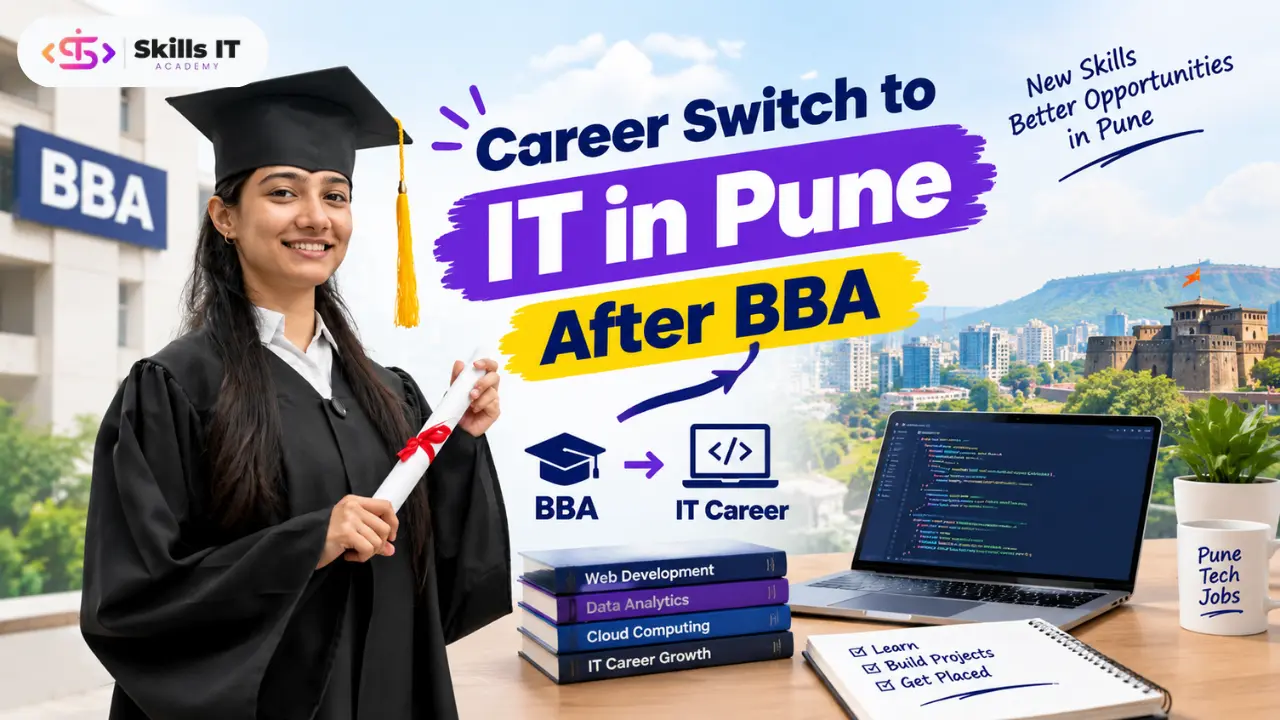
A BBA degree opens doors to diverse career paths beyond traditional roles in business, management, sales, marketing, finance, or operations.
Today, many BBA graduates are exploring technology careers because IT has become an important part of almost every industry. From software development and testing to data analytics and business technology, there are several areas where business knowledge and technical skills can work together.
One of the first questions BBA graduates ask is
Can I switch to IT after BBA?
Yes. A BBA graduate can learn technical skills and move toward suitable IT or technology-related roles.
However, the transition requires more than simply completing an IT certification.
You need to understand the type of IT role you want, learn the relevant technical skills, practice them, build projects, and prepare for technical interviews.
The more useful question is therefore not
“Which IT course is best after BBA?”
It is:
“Which IT career path matches my interests, existing skills, and career goals?”
For students and working professionals in Pune, possible paths include software development, software testing, data analytics, data science, and cloud or DevOps.
This guide explains the major options, skills required, learning roadmap, common mistakes, and factors to consider before making a career switch from BBA to IT.
Quick Answer: Can You Switch to IT After BBA?
Yes, you can switch to IT after completing a BBA.
However, your BBA degree and an IT course serve different purposes.
Your BBA may have given you exposure to:
- Business management
- Marketing
- Finance
- Operations
- Communication
- Business processes
- Basic statistics
- Management principles
An IT career may require additional technical skills such as
- Programming
- SQL
- Databases
- Software testing
- Data analysis
- Web development
- APIs
- Git/GitHub
- Cloud technologies
- Automation tools
The right learning path depends on the type of work you want to do.
For example, someone interested in software development may need to learn Java or Python, databases, frameworks, APIs, Git, and application development.
Someone interested in data analytics may need to learn Excel, SQL, Python, statistics, Power BI, Tableau, and data visualization.
Someone interested in software testing may focus on manual testing, SQL, API testing, automation, and testing frameworks.
Therefore, start with the target career role, and then select the appropriate IT course.
Why Are BBA Graduates Considering a Career in IT?
Technology is no longer limited to traditional software companies.
Businesses use technology for:
- Sales
- Marketing
- Finance
- Customer management
- Human resources
- Operations
- Reporting
- Business intelligence
- Data analysis
- Supply chain management
This trend means technology and business are increasingly connected.
A BBA graduate already understands basic business concepts.
By adding technical skills, you can develop a combination of:
Business Knowledge + Technology Skills
This combination can be useful in technology-driven business environments.
However, students should not assume that a BBA degree automatically provides an advantage in every IT role.
Software development, testing, analytics, and cloud roles have their own technical requirements. You still need to build the skills expected for your target position.
Best IT Courses to Consider After BBA in Pune
There is no single IT course that is suitable for every BBA graduate.
Your choice should depend on what type of work you enjoy and what kind of role you want to pursue.
Some common options include
- Java Full Stack Development
- Python Full Stack Development
- Software Testing
- Data Analytics
- Data Science
- Cloud and DevOps
Let's understand each career direction in more detail.
1. Java Full Stack Development After BBA
Java full-stack development can be considered by BBA graduates who are interested in programming and software development.
A comprehensive Java full-stack learning path may include:
Programming Fundamentals
↓
Core Java
↓
Object-Oriented Programming
↓
SQL
↓
JDBC
↓
Spring
↓
Spring Boot
↓
REST APIs
↓
Hibernate/JPA
↓
Frontend Technologies
↓
Git/GitHub
↓
Projects
The course requires regular coding practice.
What Skills Can You Learn?
A Java full-stack program may cover:
- Java fundamentals
- Object-oriented programming
- Collections
- Exception handling
- SQL
- Database concepts
- JDBC
- Spring
- Spring Boot
- REST APIs
- Hibernate/JPA
- Frontend technologies
- Git/GitHub
- Testing
- Application development
- Project implementation
Who Should Consider Java Full Stack?
This path may be suitable if you:
- Enjoy coding
- Want to learn software development
- Like solving technical problems
- Want to build applications
- Are willing to practice regularly
- Are comfortable learning technical concepts from the beginning
Your BBA background does not prevent you from learning Java.
However, you should understand that software development requires consistent practice. Watching classes without writing code yourself is unlikely to provide enough practical experience.
2. Python Full-Stack Development After BBA
Python full-stack development is another option for graduates interested in software and web application development.
A typical Python full-stack program may include:
- Python
- Object-oriented programming
- SQL
- Database concepts
- HTML
- CSS
- JavaScript
- Backend development
- Django or another backend framework
- REST APIs
- Git/GitHub
- Projects
The learning path may look like this:
Python
↓
OOP
↓
SQL
↓
Web Development
↓
Backend Framework
↓
APIs
↓
Frontend
↓
Git/GitHub
↓
Projects
Who Should Consider Python Full Stack?
You may want to consider this path if you are interested in:
- Python programming
- Web development
- Backend development
- Application development
- Building software projects
Python is widely discussed in areas such as development, automation, data, and AI, but students should still choose a course based on the specific career direction they want to pursue.
A basic Python programming course and a complete Python full-stack program are also very different in terms of curriculum and learning requirements.
3. Software Testing After BBA
Software testing can be another option for BBA graduates interested in entering the technology industry.
Software testers work with applications to identify defects, verify functionality, and check whether software behaves according to requirements.
A comprehensive testing course may cover:
- Manual testing
- Test cases
- Test scenarios
- SDLC
- STLC
- Bug reporting
- SQL
- API testing
- Automation testing
- Selenium
- Testing frameworks
- Automation projects
Why Consider Software Testing After BBA?
Testing involves understanding requirements, user workflows, expected results, and application behavior.
For example, imagine an online shopping application.
A tester may need to check:
- Can a user register?
- Can the user log in?
- Does product search work?
- Can products be added to the cart?
- Does payment work correctly?
- Is the order created successfully?
- What happens when incorrect information is entered?
This requires structured thinking and attention to detail.
A BBA graduate may already have some exposure to business processes and structured problem-solving, but technical testing skills still need to be developed.
4. Data Analytics After BBA
Data analytics can be an interesting career direction for BBA graduates who enjoy numbers, reporting, business performance, and decision-making.
A BBA curriculum may already provide exposure to business concepts and basic quantitative analysis.
Data analytics adds technical tools that allow you to work with larger datasets and create meaningful reports and dashboards.
A typical learning path may include:
Excel
↓
SQL
↓
Data Cleaning
↓
Statistics
↓
Python
↓
Power BI / Tableau
↓
Data Visualization
↓
Analytics Projects
What Skills Are Important?
A learner may need to develop:
- Advanced Excel
- SQL
- Python
- Statistics
- Data cleaning
- Data analysis
- Power BI
- Tableau
- Data visualization
- Dashboard development
- Analytical thinking
- Business interpretation
Why Can a BBA Background Be Useful in Data Analytics?
Consider a sales dashboard.
Knowing how to create a chart is only one part of the process.
You also need to understand questions such as
- Which products are generating the most revenue?
- Why did sales decline?
- Which region is performing better?
- Which customer segment is generating more business?
- What is the monthly growth rate?
Business knowledge can help you understand these questions.
Technical analytics skills help you collect, process, analyze, and visualize the data.
This creates an interesting combination:
Business Understanding + Data Skills
However, students still need to develop strong technical abilities in SQL, analytics tools, and other relevant technologies.
5. Data Science After BBA
Data science is another possible technology path, but it generally requires deeper technical knowledge than basic data analytics.
A data science program may include:
- Python
- Statistics
- Probability
- Data analysis
- NumPy
- Pandas
- Data visualization
- Machine learning
- Model development
- AI concepts
- Projects
Should Every BBA Graduate Choose Data Science?
No.
Data science can require considerable learning in:
- Programming
- Statistics
- Mathematics
- Data analysis
- Machine learning
If you are completely new to programming, jumping directly into advanced machine learning topics can be challenging.
A learner should first understand the foundations required for the program.
If your primary interest is business reporting and dashboards, data analytics may be a more relevant starting point than immediately choosing an advanced data science program.
6. Cloud and DevOps After BBA
Cloud and DevOps is another technical career direction.
A cloud or DevOps learning path may include:
- Linux
- Networking fundamentals
- Git
- Cloud platforms
- AWS/Azure/GCP concepts
- Docker
- CI/CD
- Jenkins
- Kubernetes
- Deployment
- Infrastructure concepts
This area can require substantial hands-on technical learning.
A BBA graduate considering cloud or DevOps should be prepared to learn technical concepts related to operating systems, networking, cloud infrastructure, deployment, and automation.
It is not simply a matter of completing a certification.
Practical experience with tools and environments is an important part of learning.
How Should You Choose an IT Course After BBA?
Instead of choosing a course because it is popular, start by understanding the type of work you enjoy.
If you enjoy coding and building applications, explore full-stack development.
If you enjoy finding software problems and checking application behavior, explore software testing.
If you enjoy numbers, reports, dashboards, and business performance, explore data analytics.
If you enjoy statistics, programming, and machine learning, explore data science.
If you enjoy servers, infrastructure, deployment, and cloud technologies, explore Cloud and DevOps.
The objective is not to find a universally “best” course.
The objective is to find a course whose curriculum matches your target career.
What Skills Do You Need for a BBA-to-IT Career Switch?
Completing a course is only one part of the transition.
You also need to develop technical and professional skills.
1. Technical Skills
Your technical skills will depend on your selected career path.
They may include:
- Programming
- SQL
- Databases
- Software testing
- Data analysis
- APIs
- Git/GitHub
- Automation
- Cloud tools
- Data visualization
The more specific your target role, the easier it becomes to identify which skills you need to learn.
2. Problem-Solving Skills
IT work involves solving problems.
You may encounter:
- Coding errors
- Database issues
- Application bugs
- API errors
- Configuration problems
- Data-quality issues
Learning how to investigate these problems is an important part of technical development.
You should gradually learn how to:
- Break a problem into smaller parts
- Search for relevant information
- Read documentation
- Test possible solutions
- Debug errors
- Understand why a solution works
3. Communication Skills
Technical professionals also need to communicate.
During an interview, you may be asked:
“Explain your project.”
You should be able to explain:
- What the project does
- Why you built it
- Which technologies you used
- How the system works
- What problems did you face?
- How you solved those problems
Your BBA background may already provide experience with presentations, communication, and business discussions.
Use that experience while developing your technical communication.
4. Project Skills
Projects are an important part of a career switch because they allow you to demonstrate practical knowledge.
For software development, projects could include:
- E-commerce applications
- Employee management systems
- Student management systems
- CRM applications
- Job portals
- Inventory management systems
For data analytics, projects could include:
- Sales dashboards
- Customer analysis
- Marketing analytics
- Revenue analysis
- Business performance dashboards
For software testing, projects could include:
- Web application testing
- Test case documentation
- API testing
- Automation testing
- Defect reporting
The objective should be to understand the project rather than simply adding a project title to your resume.
BBA to IT Career Switch: A Practical Roadmap
A career transition becomes easier when you divide it into manageable stages.
Step 1: Identify Your Target Role
Before selecting a course, decide what type of IT work interests you.
For example:
Business + Data
↓
Data Analytics
Or:
Coding + Application Development
↓
Full-Stack Development
Or:
Software Quality + Technical Testing
↓
Software Testing
Or:
Infrastructure + Technology Systems
↓
Cloud / DevOps
Starting with the target role can help you avoid choosing a course simply because it is currently popular.
Step 2: Learn the Fundamentals
Once you identify the direction, start with the basics.
For development:
Programming → OOP → Database → Framework → APIs
For analytics:
Excel → SQL → Statistics → Python → Visualization
For testing:
Testing Fundamentals → SQL → API Testing → Automation
For Cloud/DevOps:
Linux → Networking → Git → Cloud → Containers → CI/CD
The exact sequence can vary by course, but the principle remains the same: build foundations before moving into advanced topics.
Step 3: Practice Regularly
Technical learning requires active practice.
Do not spend all your learning time watching lectures.
Set aside time for:
- Coding
- Assignments
- Exercises
- Debugging
- SQL practice
- Tool usage
- Project work
Even a few hours of consistent practice can be more useful than irregular long study sessions.
Step 4: Build Practical Projects
After learning the fundamentals, start building projects.
A project can help you understand how different concepts work together.
For example, a software project may involve:
Requirements
↓
Database
↓
Backend
↓
Frontend
↓
API
↓
Testing
↓
Git
↓
Deployment
You should be able to explain the technical decisions you made rather than simply showing the final application.
Step 5: Build Your Technical Resume
Your resume should clearly show your transition.
You can include:
- BBA education
- Technical skills
- Projects
- Tools
- Certifications
- Relevant experience
- Professional skills
Do not try to hide your BBA background.
Instead, explain the progression:
BBA → Business Knowledge → Technical Training → Practical Projects → IT Career Direction
This provides a clearer story about why you are moving into technology.
Step 6: Prepare for Interviews
Interview preparation should begin before you start applying.
Depending on your target role, you may need to prepare for:
- Technical questions
- Programming questions
- SQL questions
- Testing concepts
- Data interpretation
- Project discussions
- Problem-solving questions
- Behavioral questions
Most importantly, understand the skills mentioned on your resume.
If you list a technology, be prepared to explain how you used it.
How Long Does It Take to Switch to IT After BBA?
There is no fixed timeline that applies to every learner.
The time required can depend on:
- Your existing technical knowledge
- Selected technology
- Course structure
- Training hours
- Practice time
- Project complexity
- Learning schedule
- Interview preparation
Someone studying full-time may have a different learning pace from someone working while studying.
Instead of focusing only on:
“How many months does an IT course take?”
also ask:
“What should I be able to do after completing the course?”
For example, by the end of a development program, you should ideally be able to explain and demonstrate the applications you built.
For analytics, you should be able to work with data, create dashboards, and explain your findings.
For testing, you should understand testing processes and be able to demonstrate practical testing work.
Can a BBA Fresher Learn Coding?
Yes.
You do not necessarily need an engineering or computer science degree to start learning programming.
However, coding requires practice.
During the early stages, you may encounter:
- Syntax errors
- Logic errors
- Debugging problems
- Database errors
- Framework issues
- Difficulty understanding technical documentation
These challenges are part of the learning process.
The goal is to gradually become better at identifying the cause of a problem and finding a solution.
Can a Working Professional Switch to IT After BBA?
Yes, but working professionals need to consider their available learning time.
A working professional may need to balance:
- Job responsibilities
- Classes
- Assignments
- Practice
- Projects
- Interview preparation
Before enrolling, check whether the course schedule fits your routine.
Important questions include:
- Are weekday or weekend batches available?
- Are online classes available?
- Are recorded resources provided?
- How can students ask questions outside class?
- Is project support available?
- How many training hours are included?
A course is only useful if you can realistically dedicate enough time to learning.
Should You Join an IT Course Immediately After BBA?
Not necessarily.
Before enrolling, spend some time understanding the career direction you are considering.
For example, if you are interested in data analytics, try learning basic Excel and SQL.
If you are interested in software development, try basic programming.
If you are interested in testing, explore basic software testing concepts.
This initial exposure can help you understand whether you actually enjoy the type of work involved.
Choosing a course only because someone says it has high demand can result in a poor fit.
Common Mistakes BBA Graduates Make When Switching to IT
Choosing a Course Only Because It Is Popular
Technology trends change.
A course should be selected according to your career objective and learning interests.
Assuming a Certificate Is Enough
A certificate can demonstrate course completion, but it does not replace practical skills.
You should be able to demonstrate what you learned.
Avoiding Practical Work
Technical skills improve through practice.
Assignments, exercises, debugging, and projects should be part of your learning process.
Learning Only Through Videos
Watching someone else write code is not the same as writing it yourself.
Try the exercises independently.
Not Building Projects
Projects help connect individual concepts into a practical application.
Starting With Advanced Topics Too Early
Learning advanced AI, cloud, or development concepts without understanding the fundamentals can make the learning process unnecessarily difficult.
Ignoring Communication Skills
You need to explain your technical work clearly during interviews and professional discussions.
Assuming a Career Switch Happens Automatically
Completing an IT course is one step in the transition.
You still need:
- Technical skills
- Practice
- Projects
- Resume preparation
- Interview preparation
- Job-search effort
How to Choose an IT Training Institute in Pune After BBA
Before joining an IT training institute, do not compare institutes only on course fees.
Look at the complete learning experience.
Check the curriculum.
Does the syllabus match your target job role?
A course called “Full Stack” or “Data Science” can contain very different topics depending on the training provider.
Read the complete syllabus.
Check Training Hours
Ask how many instructor-led hours are included.
A course duration of six months does not tell you how much actual classroom or live training you will receive.
Check Practical Training
Ask:
How much practical work will I actually complete?
Find out whether the program includes:
- Coding exercises
- Assignments
- Lab work
- Debugging
- Tool practice
- Practical assessments
Check Projects
Ask:
- How many projects are included?
- Will I build them myself?
- Will trainers provide guidance?
- Will my work be reviewed?
- Will I learn Git/GitHub?
- Will I understand the complete project?
Check Trainer Support
Find out how students receive help when they get stuck.
Important areas include:
- Doubt solving
- Code review
- Project guidance
- Technical discussions
- Interview preparation
Check Batch Size
Batch size can affect the amount of individual interaction available.
Ask how students receive personal feedback and whether trainers review assignments or projects.
Check Career Support
If an institute mentions career or placement assistance, ask what that actually includes.
For example:
- Resume guidance
- Mock interviews
- Technical interview preparation
- Job opportunity updates
- Career counselling
- Interview scheduling support
Do not assume that “placement assistance” means guaranteed employment.
Why Consider Skills IT Academy for a BBA-to-IT Career Switch?
Students considering Skills IT Academy can evaluate its current IT programs based on the same factors they should use when comparing training providers.
Before enrollment, review:
- Current course syllabus
- Course duration
- Training hours
- Technologies covered
- Practical sessions
- Projects
- Trainer details
- Batch format
- Assessments
- Interview preparation
- Resume guidance
- Career assistance
- Placement support
- Current course fee
Course fees, schedules, course structures, and included services can change. Students should therefore confirm the latest information directly with Skills IT Academy before enrolling.
The goal should be to select a program based on your intended career path and the skills you need to develop.
BBA to IT Career Path: Data Analytics Example
A BBA graduate interested in business and data can follow a learning path such as
BBA
↓
Excel
↓
SQL
↓
Statistics
↓
Python
↓
Power BI / Tableau
↓
Data Analysis
↓
Business Analytics Projects
↓
Resume Preparation
↓
Interview Preparation
This path combines existing business knowledge with technical data skills.
BBA to IT Career Path: Software Testing Example
A learner interested in software quality may follow:
BBA
↓
Software Testing Fundamentals
↓
Manual Testing
↓
SQL
↓
API Testing
↓
Automation Testing
↓
Testing Projects
↓
Resume Preparation
↓
Interview Preparation
This path requires learning both testing concepts and practical tools.
BBA to IT Career Path: Full Stack Development Example
A BBA graduate interested in software development may follow:
BBA
↓
Programming Fundamentals
↓
Java / Python
↓
OOP
↓
SQL
↓
Backend Framework
↓
Frontend Development
↓
REST APIs
↓
Git/GitHub
↓
Projects
↓
Interview Preparation
The learner should be prepared for consistent programming practice throughout the process.
Frequently Asked Questions About Switching to IT After BBA
1. Can I switch to IT after BBA?
Yes. BBA graduates can learn technical skills and pursue suitable technology-related career paths.
The required skills depend on the target role.
2. Which IT course should I choose after BBA?
Possible options include Java Full Stack, Python Full Stack, Software Testing, Data Analytics, Data Science, and Cloud/DevOps.
The appropriate option depends on your interests, existing skills, learning ability, and target career.
3. Can a BBA graduate learn programming?
Yes. Programming can be learned without an engineering or computer science degree.
However, beginners should expect to spend significant time practicing and solving problems.
4. Is data analytics suitable for BBA graduates?
Data analytics can be relevant for BBA graduates interested in business data, reporting, numbers, dashboards, and decision-making.
Skills such as Excel, SQL, Python, statistics, and Power BI can be useful.
5. Can I become a software developer after BBA?
Yes, but you will need to develop programming and software development skills.
A full-stack development program can provide a structured learning path covering programming, databases, frameworks, APIs, and projects.
6. Can I enter software testing after BBA?
Yes.
You can learn manual testing, SQL, API testing, automation tools, and testing frameworks.
Your BBA background may also help you understand business processes and application workflows, although technical testing skills still need to be developed.
7. Is data science difficult for a BBA graduate?
Data science can require programming, mathematics, statistics, data analysis, and machine learning.
A learner from a non-technical background may need additional time to build these foundations.
8. Do I need an engineering degree to enter IT?
Not every technology role requires an engineering degree.
However, educational requirements vary by employer and position.
Relevant technical skills, practical knowledge, projects, and interview performance can also be important factors.
9. How long does it take to switch from BBA to IT?
There is no universal timeline.
The learning period depends on the selected technology, course structure, previous knowledge, practice time, and learning schedule.
10. Is an IT certification enough to get a job after a BBA?
A certification should not be treated as a guarantee of employment.
Students should also develop practical skills, projects, problem-solving ability, communication skills, and interview readiness.
11. Can a working BBA professional learn IT?
Yes.
Working professionals can consider classroom, online, weekend, or other flexible learning options depending on the available course schedule.
12. What should I check before joining an IT course in Pune?
Compare:
- Complete syllabus
- Training hours
- Practical sessions
- Projects
- Trainer support
- Batch size
- Learning format
- Course fee
- Interview preparation
- Career assistance
Also confirm whether any additional charges apply.
Final Takeaway: Career Switch to IT After BBA in Pune
A BBA degree does not prevent you from building a career in technology.
However, the transition requires deliberate skill development.
A practical career-switching process can look like this:
BBA
↓
Choose a Target IT Role
↓
Select the Relevant Course
↓
Learn the Fundamentals
↓
Practice Regularly
↓
Build Practical Projects
↓
Develop a Technical Resume
↓
Prepare for Interviews
↓
Apply for Relevant Opportunities
The important decision is not simply choosing the most popular IT course.
It is choosing a learning path that matches:
Your Interest + Target Role + Learning Ability + Available Time + Career Objective
If you are considering a career switch to IT after BBA in Pune, review the available programs at Skills IT Academy, compare the curriculum and practical training, and confirm the latest course fee, duration, schedule, and career-support services before enrollment.