What Happens After You Apply for an IT Job?
Skills IT Academy Content Team
November 4, 2026
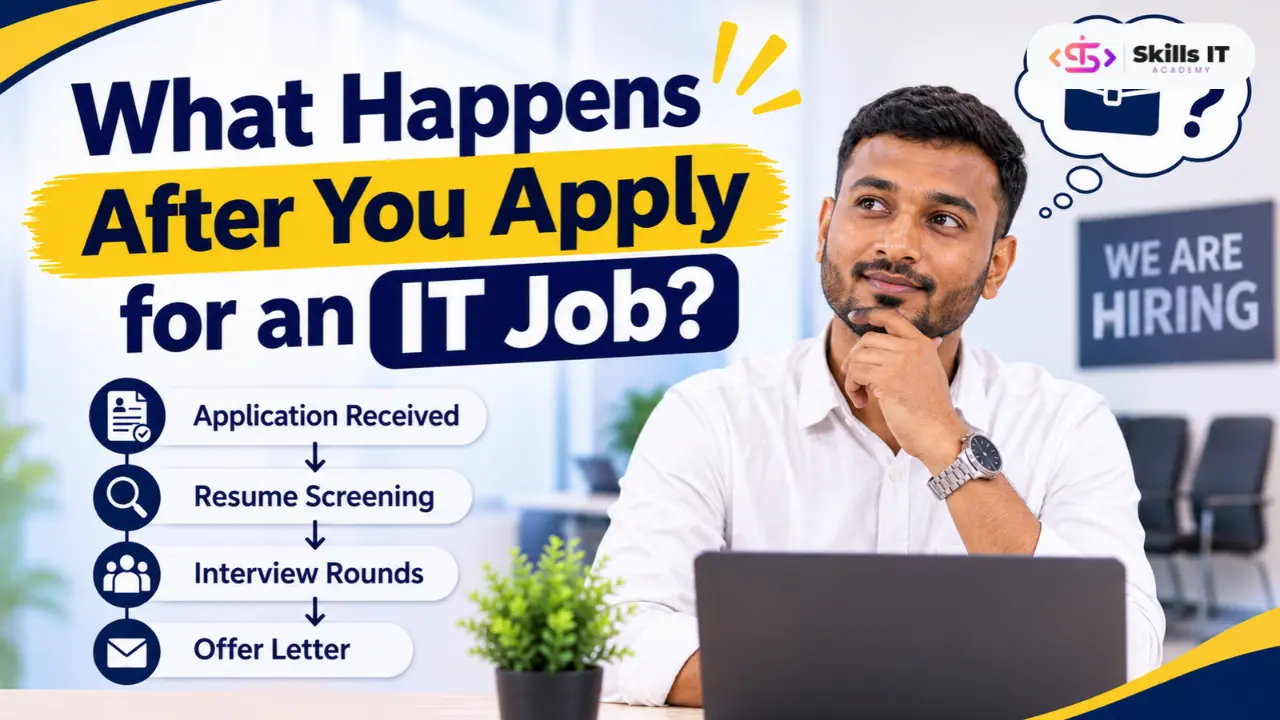
Applying for your first IT job is an exciting step towards building a career in the technology industry. However, many freshers and graduates have questions about what happens after submitting a job application.
Does a recruiter check your resume? How do companies shortlist candidates? What happens during technical interviews? How many interview rounds are conducted before receiving a job offer?
Understanding the IT recruitment process can help freshers prepare better and approach job opportunities with confidence.
Whether you are applying for a software developer, Java developer, Python developer, data analyst, or DevOps engineer position, knowing the hiring process is important for starting your IT career.
In this guide, let's understand what happens after you apply for an IT job and how you can prepare for each stage.
1. Your Resume Is Reviewed by the Recruitment Team
After submitting your IT job application, the first step is usually resume screening.
Recruiters review your resume to understand your educational qualifications, technical skills, projects, certifications, and relevant experience.
For freshers, recruiters may particularly look for:
- Educational qualifications and graduation details.
- Programming knowledge such as Java or Python.
- Technical skills relevant to the job role.
- Academic or practical projects.
- Internship or training experience.
- Problem-solving and communication skills.
Some companies also use Applicant Tracking Systems (ATS) to filter applications based on relevant keywords and job requirements.
Tip for freshers: Create a professional resume that highlights your technical skills, projects, certifications, and practical knowledge.
2. Shortlisting and Initial HR Communication
If your resume matches the company's requirements, your application may move to the shortlisting stage.
The recruitment team may contact you through email or phone to discuss your application.
During this stage, recruiters may ask about:
- Your educational background.
- Your technical skills.
- Your preferred job role.
- Your current location.
- Your availability to join.
- Your salary expectations, if applicable.
You may also receive information about the next interview round.
Tip for freshers: Keep your phone and email active, check your inbox regularly, and respond professionally to recruitment communications.
3. Online Assessment or Technical Test
Many IT companies conduct an online assessment to evaluate candidates' technical knowledge and problem-solving abilities.
The assessment depends on the job role and company's recruitment process.
Common assessment areas include:
- Programming fundamentals.
- Logical reasoning.
- Quantitative aptitude.
- Data structures and algorithms.
- SQL and database concepts.
- Basic technical knowledge.
- Coding problems.
For example, candidates applying for Java Developer positions may be tested on Core Java, OOP concepts, and programming logic.
Python Developer applicants may receive questions related to Python fundamentals, functions, data structures, and coding problems.
Tip for freshers: Practice coding regularly, revise programming fundamentals, and solve technical questions before attending assessments.
4. Technical Interview Round
After successfully clearing the assessment, candidates may be invited for a technical interview.
This is one of the most important stages of the IT hiring process.
The interviewer evaluates your technical knowledge, practical understanding, and ability to solve problems.
Depending on the job role, questions may cover:
For Java Developer Roles:
- Core Java.
- Object-Oriented Programming.
- Collections Framework.
- Exception Handling.
- SQL and database concepts.
- Java-based projects.
For Python Developer Roles:
- Python fundamentals.
- Data types and functions.
- Object-Oriented Programming.
- Python libraries.
- Database connectivity.
- Project-related questions.
For Data Analyst Roles:
- SQL.
- Microsoft Excel.
- Data Cleaning.
- Data Analysis.
- Power BI.
- Data Visualization.
For DevOps Roles:
- Linux fundamentals.
- Git and version control.
- Docker.
- CI/CD concepts.
- Automation fundamentals.
- Software deployment.
Tip for freshers: Do not focus only on theoretical knowledge. Practise explaining your projects, writing code, and solving real-world technical problems.
5. Practical or Project-Based Interview
Some IT companies conduct an additional practical assessment or project discussion.
During this stage, interviewers may ask you to demonstrate how you apply your technical knowledge.
For example:
- Develop a basic web application.
- Write SQL queries.
- Solve a programming problem.
- Explain your final-year project.
- Create a dashboard using Power BI.
- Identify and solve technical errors.
Practical knowledge helps employers understand how well you can apply concepts in real working situations.
Tip for freshers: Build at least two or three practical projects related to your chosen IT domain and understand every part of your project.
6. HR Interview Round
After technical evaluation, shortlisted candidates may attend an HR interview.
This round generally focuses on communication skills, professional behavior, career interests, and job expectations.
Common HR interview questions include:
- Tell me about yourself.
- Why do you want to work in the IT industry?
- What are your strengths and weaknesses?
- Why should we hire you?
- Are you comfortable working in a team?
- Are you willing to relocate?
- What are your career goals?
Recruiters may also discuss company policies, work location, salary expectations, and joining availability.
Tip for freshers: Prepare clear and honest answers. Practise introducing yourself and explaining your career goals confidently.
7. Final Selection and Job Offer
If you successfully complete the required interview rounds, the company may select you for the position.
The HR team may communicate the selection decision through email or phone.
Selected candidates may receive an offer letter containing details such as:
- Job designation.
- Salary package.
- Employment terms.
- Work location.
- Joining date.
- Other company policies.
Read the offer letter carefully and clarify any doubts before accepting it.
Remember that the number of interview rounds and selection criteria can vary between companies.
8. Document Verification and Joining Formalities
After accepting the offer, the company may begin the document verification and onboarding process.
Freshers may be asked to provide documents such as:
- Updated resume.
- Educational certificates.
- Graduation marksheets.
- Government-issued identity and address proof.
- Passport-size photographs.
- Other documents requested by the employer.
Once the required formalities are completed, the company will share joining instructions and onboarding details.
Your IT career journey officially begins when you join the organization.
How Can Freshers Prepare for IT Job Interviews?
Getting an IT job requires more than submitting applications. Candidates need technical knowledge, practical experience, communication skills, and interview preparation.
Here are some important steps freshers should follow:
- Choose a technical domain based on your interests and career goals.
- Learn programming fundamentals.
- Practice coding and problem-solving regularly.
- Work on practical projects.
- Prepare a professional ATS-friendly resume.
- Practice technical and HR interview questions.
- Improve communication and presentation skills.
- Apply for relevant entry-level IT job opportunities.
- Prepare for technical assessments and interviews.
- Continue learning and improving your technical knowledge.
Which IT Skills Should Freshers Learn Before Applying for Jobs?
The technical skills you need depend on the job role you want to pursue.
Here are some popular IT career paths and the skills associated with them.
1. Full Stack Java Development
Students interested in software development can explore:
- Core Java.
- Object-Oriented Programming.
- SQL.
- Backend Development.
- Frontend Development.
- Full Stack Application Development.
Possible career roles include Java Developer, Backend Developer, and Junior Software Developer.
2. Full Stack Python Development
Students interested in Python programming can learn:
- Python Fundamentals.
- Functions and Modules.
- Object-Oriented Programming.
- Database Connectivity.
- Backend Development.
- Web Application Development.
Possible career roles include Python Developer, Backend Developer, and Junior Software Developer.
3. Data Science
Students interested in programming and data can explore:
- Python for Data Science.
- Data Cleaning.
- Data Analysis.
- Statistical Concepts.
- Data Visualization.
- Introduction to Machine Learning.
Possible career roles include junior data scientist and data analyst.
4. Data Analytics
Students interested in working with business data can learn:
- Microsoft Excel.
- SQL.
- Data Cleaning.
- Power BI.
- Data Visualization.
- Dashboard Development.
Possible career roles include data analyst, reporting analyst, and junior business analyst.
5. DevOps
Students interested in automation and software deployment can explore:
- Linux Fundamentals.
- Git.
- DevOps Fundamentals.
- CI/CD.
- Docker.
- Containerization.
- Software Deployment.
Possible career roles include Junior DevOps Engineer and DevOps Support Engineer.
How Skills IT Academy Helps Freshers Prepare for IT Careers
Learning relevant technical skills and preparing for interviews are important steps towards entering the IT industry.
Skills IT Academy, located in Karve Nagar, Pune, offers industry-oriented IT training programs for students, graduates, freshers, and working professionals.
The institute provides training options in:
- Full Stack Java.
- Full Stack Python.
- Data Science.
- DevOps.
- Data Analytics.
These programs help learners develop technical knowledge and understand concepts related to different IT job roles.
Students exploring IT training in Pune can also inquire about available placement assistance and career preparation services, including:
- Resume preparation guidance.
- Technical interview preparation.
- HR interview guidance.
- Mock interview sessions.
- Practical project experience.
- Job application guidance.
- Career counselling.
Important: Placement assistance is not the same as guaranteed job placement. Students should confirm the available services and placement policies directly with the institute.
Conclusion
The IT job recruitment process generally includes resume screening, shortlisting, technical assessments, technical interviews, HR interviews, final selection, and onboarding.
However, every company follows its own recruitment process, and the number of interview rounds may vary depending on the job role and experience requirements.
For freshers, the best way to prepare is to develop strong technical fundamentals, gain practical project experience, build a professional resume, and practice interview questions.
If you are planning to start your IT career, explore relevant technical training programs at Skills IT Academy in Karve Nagar, Pune.
Skills IT Academy
Location: Karve Nagar, Pune, Maharashtra
Website: https://www.skillsitacademy.com/
Contact: 9168949596
Take the first step towards building your technical skills and preparing for IT job opportunities.
Frequently Asked Questions (FAQs)
1. What happens after applying for an IT job?
After applying, your resume is generally reviewed by the recruitment team. If shortlisted, you may be invited for an online assessment, technical interview, HR interview, and further selection or onboarding formalities.
2. How many interview rounds are there in IT companies?
The number of interview rounds varies between companies. Some conduct two or three rounds, while others may include additional technical assessments, practical tests, or managerial interviews.
3. What do IT companies check in a fresher's resume?
Recruiters generally review educational qualifications, technical skills, programming knowledge, projects, certifications, internships, and other relevant information.
4. Is coding necessary for getting an IT job?
Coding is essential for many software development roles. However, requirements vary by job profile. Data analytics, testing, technical support, and other IT roles may require different combinations of technical skills.
5. What questions are asked in IT technical interviews for freshers?
Freshers may be asked questions about programming fundamentals, Java, Python, SQL, OOP concepts, logical reasoning, data structures, and their academic or practical projects.
6. How should freshers prepare for an IT interview?
Freshers should learn technical fundamentals, practice coding, work on projects, prepare their resumes, revise common interview questions, and improve communication skills.
7. Can non-IT students apply for IT jobs?
Yes. Non-IT graduates can explore various IT career opportunities depending on their technical skills, qualifications, and the eligibility requirements of individual employers.
8. Which programming language should freshers learn first?
Python and Java are popular starting options. The right choice depends on your interests and career goals. Python is used in development, automation, and data-related fields, while Java is widely used in enterprise software development.
9. Does Skills IT Academy provide placement assistance?
Skills IT Academy offers IT training programs in Java, Python, Data Science, DevOps, and Data Analytics. Students can directly contact the institute to confirm available placement assistance and career preparation services.
10. Where can I learn IT skills in Pune?
Students looking for IT training in Pune can explore Skills IT Academy in Karve Nagar. The institute offers multiple technical training programs for students, freshers, and working professionals.