How to Move from BPO to IT Jobs in Pune with Short-Term Courses
Skills IT Academy Content Team
September 18, 2026
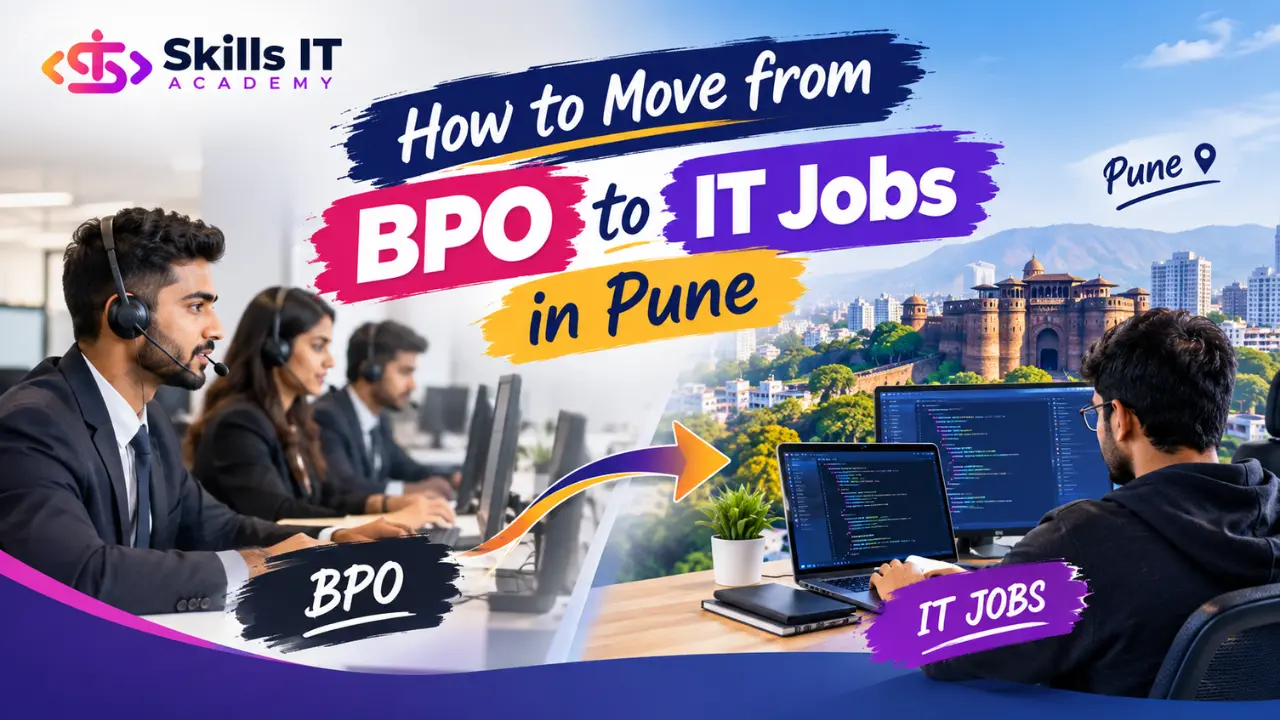
For many BPO professionals, working in customer support, technical support, operations, or back-office processes can be a useful starting point for a career. However, after gaining experience, some professionals begin looking for opportunities in software development, testing, data, cloud computing, or other IT roles.
This often leads to an important question:
Can you move from a BPO job to an IT job in Pune by completing a short-term course?
The practical answer is yes. A short-term IT course can help a BPO professional develop technical skills and prepare for entry-level IT opportunities. However, completing a course alone does not guarantee an IT job.
A successful career transition usually requires a combination of:
- Technical skills
- Practical projects
- Programming knowledge
- Problem-solving ability
- Communication skills
- Resume preparation
- Interview preparation
- Relevant experience
- Consistent practice
- Understanding of the target IT role
For someone already working in a BPO, the transition can be approached as a structured career change rather than simply joining a course and waiting for placement.
A practical pathway can look like this:
BPO Experience → Choose an IT Role → Select a Short-Term Course → Learn Technical Skills → Build Projects → Create an IT-Focused Resume → Prepare for Interviews → Apply for IT Jobs
For professionals searching for a software training institute in Pune, understanding this process can help them select a course based on their actual career objective rather than choosing a course only because it is popular.
Quick Answer: Can BPO Professionals Move into IT Jobs?
Yes, BPO professionals can transition into IT roles by developing relevant technical skills and building practical experience.
Your existing BPO experience can provide useful transferable skills such as
- Communication
- Customer interaction
- Problem solving
- Teamwork
- Time management
- Process management
- Documentation
- Handling business requirements
- Working under deadlines
However, technical IT roles usually require additional skills.
For example, someone targeting a Java developer position may need to learn:
Java → OOP → SQL → Spring Boot → REST APIs → Git → Testing → Projects
Someone targeting software testing may need:
Testing Fundamentals → Manual Testing → SQL → API Testing → Programming → Selenium → Automation → Projects
Therefore, the objective should not be to completely discard your BPO experience.
Instead, build a profile that combines your existing professional skills with new technical capabilities.
Why Are BPO Professionals Moving Towards IT Careers?
BPO work can provide valuable professional experience, but career goals can change over time.
Some professionals may discover that they are more interested in technology and software development. Others may have completed an engineering, BCA, BSc IT, MCA, or another technical qualification but started their career in a BPO role.
Common reasons for considering an IT transition include:
Career Growth
Some professionals want to move toward technical career paths where they can continuously develop specialized skills.
Interest in Technology
A person working in a BPO may develop an interest in programming, software applications, databases, automation, or cloud technologies.
Educational Background
Some graduates enter BPO roles because they need immediate employment after graduation. Later, they may decide to use their educational background to pursue an IT career.
Professional Development
Learning a technical skill can provide an opportunity to move into a different type of professional role.
Long-Term Career Planning
Instead of remaining in the same career path indefinitely, professionals may decide to develop skills for software development, testing, data analytics, cloud, or another IT specialization.
The important point is that switching careers requires preparation. A BPO professional should identify the target role first and then determine which technical skills are required.
Can BPO Experience Help You in an IT Career?
Yes, some BPO skills can be transferable to IT jobs.
However, transferable skills should complement technical knowledge rather than replace it.
Communication Skills
IT professionals regularly communicate with:
- Team members
- Managers
- Clients
- Business teams
- QA teams
- Developers
- Product teams
Strong communication can therefore be useful during an IT career transition.
Problem-Solving Skills
BPO professionals often handle customer issues, process problems, complaints, or operational challenges.
Software professionals also solve problems, although the problems are technical and require programming or technology knowledge.
Documentation
BPO employees may already have experience documenting customer issues, processes, resolutions, or activities.
Documentation is also important in software projects.
Teamwork
Working with teams is common in both BPO and IT environments.
Time Management
Meeting deadlines and handling multiple tasks are useful professional skills across industries.
However, a BPO professional moving into software development cannot rely only on these transferable skills. Technical competence must also be demonstrated.
Which IT Jobs Can BPO Professionals Target?
There is no single IT role that is suitable for every BPO professional.
The right choice depends on your education, interests, existing experience, and willingness to learn technical skills.
Some possible pathways include:
Java Developer
Java can be considered by learners interested in backend or full-stack software development.
A learning pathway can include:
Core Java → Object-Oriented Programming → Collections → SQL → Spring → Spring Boot → REST APIs → JPA/Hibernate → Testing → Git → Projects
Full Stack Developer
Full-stack development combines frontend and backend technologies.
A possible learning pathway is
HTML → CSS → JavaScript → React → Java/Spring Boot → SQL → REST APIs → Git → Testing → Projects
Software Testing
Testing can be another pathway for people interested in software quality and application testing.
A possible learning sequence is
Testing Fundamentals → Manual Testing → SQL → API Testing → Programming → Selenium → Automation Frameworks → CI/CD → Projects
Python Development
Python can be used across backend development, automation, AI, and data-related applications.
A learning pathway could include:
Python → OOP → SQL → APIs → Backend Framework → Database → Testing → Projects
Data Analytics
Professionals interested in working with business data may consider a data analytics pathway involving:
Excel → SQL → Python → Data Analysis → Data Visualization → Projects
Cloud and DevOps
Professionals interested in infrastructure and deployment can explore:
Linux → Networking → Git → Cloud → CI/CD → Containers → Deployment → Monitoring
The important principle is simple:
Choose the IT role first. Then choose the course and technology stack.
Which Short-Term Course Should a BPO Professional Choose?
The answer depends on the career direction.
Do not choose a course simply because someone says it is the "best IT course."
Instead, ask:
What job do I want after completing the course?
For example:
If your goal is software development, consider a programming-focused course.
If your goal is QA, explore software testing and automation.
If you are interested in business data, investigate data analytics.
If you are interested in infrastructure, explore cloud and DevOps.
If you want to develop both frontend and backend applications, full-stack development may be a relevant pathway.
The course should provide enough depth to build practical ability rather than simply providing exposure to many technologies.
What Should a Short-Term IT Course Include?
Before enrolling, examine the curriculum carefully.
A useful technical program should ideally provide opportunities to learn:
- Programming fundamentals
- Object-oriented programming
- SQL
- Databases
- APIs
- Git and GitHub
- Debugging
- Testing
- Development practices
- Practical projects
- Interview preparation
The exact subjects will depend on the course.
For example, a Java-oriented program may progress from programming fundamentals to backend development and projects.
A testing program may focus on manual testing, SQL, API testing, programming, and automation.
A cloud program may focus more heavily on Linux, networking, cloud platforms, and deployment.
The goal should be to develop skills that you can demonstrate during an interview.
Why Should BPO Professionals Learn Programming?
Programming is not necessary for every IT role, but it is essential for many technical software-development careers.
Programming teaches you how to:
- Break down problems
- Write logical solutions
- Work with data
- Build applications
- Debug errors
- Understand software behavior
- Automate repetitive tasks
For someone moving from BPO to software development, programming may initially feel difficult.
That is normal.
Instead of trying to learn everything at once, start with fundamentals.
For example:
Variables → Conditions → Loops → Functions → OOP → Collections → Exception Handling → Database Connectivity → APIs
Once the fundamentals become comfortable, advanced frameworks become easier to understand.
Why Are Projects Important When Switching from BPO to IT?
One of the biggest challenges for career switchers is demonstrating practical technical ability.
Your BPO experience shows that you have worked professionally.
Your IT projects can show that you have developed technical skills.
For example, you could build:
- Employee Management System
- Student Management System
- Inventory Management System
- Job Portal
- E-commerce Application
- Banking Application
- CRM Application
However, simply having project names on a resume is not enough.
You should understand what you built.
During an interview, you may need to explain:
- What problem does the application solve?
- Why did you select the technology?
- How is the database designed?
- How do the APIs work?
- How does authentication work?
- How does the frontend communicate with the backend?
- What problems did you encounter?
- How did you debug them?
- How did you test the application?
- What part did you personally develop?
A project becomes more valuable when you can confidently explain the decisions behind it.
How Should You Build Projects During a Short-Term Course?
Do not try to build a large application on your first day.
Use progressive learning.
Project 1: Basic Application
Start with a simple application that helps you understand programming and database fundamentals.
Project 2: Database-Based Application
Add database operations such as
- Create
- Read
- Update
- Delete
Project 3: Application with APIs
Learn how different components communicate through REST APIs.
Project 4: Complete Business Application
Build something that combines:
- Frontend
- Backend
- Database
- Authentication
- APIs
- Validation
- Error handling
- Testing
This gives you a stronger foundation for explaining your technical ability during interviews.
How Can You Convert a BPO Resume into an IT Resume?
This is one of the most important steps in the career transition.
Do not simply delete your BPO experience.
Instead, restructure your resume to show your career transition.
Your resume can contain:
Professional Summary
Explain that you have professional experience and have developed technical skills for your targeted IT role.
Technical Skills
List the technologies you can actually discuss.
For example:
Java | SQL | Spring Boot | REST APIs | Git | HTML | CSS | JavaScript
Do not list technologies you have never practically used.
Projects
Explain:
- Project name
- Technology used
- Purpose
- Your contribution
- Important functionality
BPO Experience
Keep your professional experience and highlight relevant transferable skills.
For example:
- Customer communication
- Issue resolution
- Process handling
- Documentation
- Team coordination
- SLA management
Education
Include your degree, college, and relevant qualifications.
Certifications
Add relevant technical certifications where applicable.
The goal is to present a clear story:
Professional Experience + Technical Training + Practical Projects + Target IT Role
Should You Hide Your BPO Experience?
No.
Your BPO experience is still professional experience.
Instead of hiding it, explain how it helped you develop professional skills while you simultaneously developed technical capabilities.
For example, a candidate could have:
Previous Experience: BPO Customer Support
New Technical Skills: Java, SQL, Spring Boot, REST APIs, and Git
Practical Evidence: Java Full Stack Projects
Career Goal: Software Developer
This makes the career transition understandable.
How Can BPO Professionals Prepare for IT Interviews?
Technical interviews may be very different from BPO interviews.
You should prepare for several areas.
Programming Questions
Practice programming fundamentals and problem-solving questions.
SQL Questions
Learn:
- SELECT
- WHERE
- JOIN
- GROUP BY
- ORDER BY
- Subqueries
- Aggregate functions
Technical Concepts
Depending on your target role, prepare concepts related to:
- Programming
- OOP
- Databases
- APIs
- Testing
- Frameworks
- Git
- Development practices
Project Questions
Be prepared to explain your projects from beginning to end.
Communication
Practice explaining technical concepts in simple language.
Your existing BPO communication experience can become useful here.
Can Communication Skills Help During an IT Interview?
Yes.
Technical knowledge is important, but IT professionals also need to communicate clearly.
You may need to explain:
- A technical problem
- A project
- A bug
- A solution
- A database design
- An API
- A development decision
Someone coming from BPO may already have experience communicating with customers or teams.
Use that experience positively, but continue developing technical communication.
The goal is to become comfortable explaining what you built, why you built it, and how it works.
How Long Does It Take to Move from BPO to IT?
There is no universal timeline.
A short-term course may provide structured learning within a limited period, but becoming job-ready depends on several factors.
These can include:
- Your educational background
- Current technical knowledge
- Course intensity
- Daily practice
- Programming ability
- Project experience
- Interview preparation
- Target job role
- Previous professional experience
- Availability of suitable vacancies
For this reason, avoid choosing an institute solely because it promises an IT job within a specific number of days or months.
Instead, evaluate what you will actually learn and what practical evidence you will have after completing the program.
Should You Quit Your BPO Job to Learn IT?
This is an individual decision.
Some professionals prefer to continue working while studying.
Others may have the financial flexibility to focus on training full-time.
Before making a decision, consider:
- Current income
- Financial responsibilities
- Course schedule
- Learning time available
- Family commitments
- Career goals
- Current technical knowledge
- Job opportunities
If possible, create a transition plan instead of making an immediate decision without preparation.
For example:
BPO Job → Evening/Weekend Learning → Technical Skills → Projects → Interview Preparation → IT Applications
This approach may allow some professionals to develop skills while maintaining employment.
How Can a Software Training Institute in Pune Help BPO Professionals?
A software training institute in Pune can support career switchers by providing structured technical education and practical guidance.
When evaluating an institute, look for:
- Structured curriculum
- Experienced trainers
- Programming fundamentals
- Practical coding
- Database training
- Project development
- Git and GitHub
- Testing
- Debugging
- Mock interviews
- Resume guidance
- Project reviews
- Career assistance
The important question is not simply:
"Does this institute provide placement?"
Instead, ask:
"What exactly will this institute help me learn, build, and prepare for?"
A strong training experience should help you become more capable of demonstrating your skills during an actual recruitment process.
How Can Skills IT Academy Support a BPO-to-IT Career Transition?
For professionals considering a transition from BPO to software development, Skills IT Academy can be evaluated based on its current technical curriculum, practical training, project work, trainer support, and career-preparation approach.
Students should review the current course details and confirm:
- Which technologies are taught
- Whether programming fundamentals are included
- How much practical coding is involved
- What projects are included
- Whether Git and GitHub are covered
- How technical doubts are handled
- Whether project reviews are provided
- Whether mock interviews are included
- Whether resume guidance is available
- What career assistance is provided
- What placement support is actually offered
For someone targeting Java or full-stack development, a structured progression can look like:
Core Java
↓
Object-Oriented Programming
↓
SQL
↓
HTML + CSS + JavaScript
↓
React
↓
Spring Boot
↓
REST APIs
↓
JPA/Hibernate
↓
Git/GitHub
↓
Testing
↓
Projects
↓
Interview Preparation
The exact course structure should always be confirmed with the institute before enrollment.
What Mistakes Should BPO Professionals Avoid When Switching to IT?
Trying to Learn Everything
You do not need to learn every programming language and framework.
Choose one career direction.
Choosing a Course Only Because It Is Short
A short course is useful only if it provides sufficient practical learning for your target role.
Collecting Certificates
Multiple certificates cannot replace technical ability.
Copying Projects
You should understand every project listed on your resume.
Ignoring SQL
Database knowledge is relevant to many software and testing roles.
Ignoring Git
Modern software development commonly involves version control and collaborative development workflows.
Focusing Only on Theory
Employers may ask what you have actually built and how you solved technical problems.
Not Practicing Interviews
Learning technology and answering interview questions are different skills.
Hiding Previous Experience
Your BPO experience can demonstrate professional maturity and transferable skills.
Expecting Guaranteed Placement
Training can support preparation, but hiring decisions depend on employers and candidate performance.
What Should You Ask at an IT Training Institute Before Joining?
Before enrolling in a short-term IT course, ask specific questions.
Curriculum Questions
- What technologies are included?
- Is programming taught from fundamentals?
- Is SQL included?
- Are APIs covered?
- Is Git included?
- Is testing included?
Practical Training Questions
- How much coding will I do?
- How many projects will I build?
- Are projects developed from scratch?
- Will trainers review my code?
- Will I learn debugging?
- Will I use GitHub?
Trainer Questions
- Who will teach the course?
- What practical experience does the trainer have?
- How are doubts handled?
- Are project reviews included?
Career Preparation Questions
- Is resume guidance included?
- Are mock interviews conducted?
- Is technical interview preparation provided?
- Will I practice project explanations?
Placement Questions
- What does placement assistance actually include?
- Are interviews arranged?
- What types of companies participate?
- Are opportunities available for career switchers?
- What happens if I am not selected?
Clear answers can help you distinguish between training, career assistance, and actual recruitment.
A Practical BPO-to-IT Roadmap
If you are currently working in a BPO and want to transition into IT, follow a structured process.
Step 1: Evaluate Your Current Profile
Understand:
- Your education
- BPO experience
- Technical knowledge
- Communication skills
- Career interests
Step 2: Select One IT Role
Choose one direction, such as
- Java Developer
- Full Stack Developer
- QA Engineer
- Automation Tester
- Data Analyst
- Technical Support
- Cloud/DevOps
Step 3: Select a Relevant Short-Term Course
Choose a course that matches the selected role.
Step 4: Learn the Fundamentals
Do not rush directly into advanced frameworks.
Build a strong foundation first.
Step 5: Practice Every Day
Programming improves through practice.
Spend time writing code rather than only watching lectures.
Step 6: Build Projects
Create projects that demonstrate practical ability.
Step 7: Create an IT-Focused Resume
Combine your BPO experience, technical skills, projects, and education.
Step 8: Build Your GitHub Profile
Upload meaningful projects and document them properly.
Step 9: Practice Interviews
Prepare for technical, HR, and project-related questions.
Step 10: Start Applying
Search for positions matching your actual skills and experience.
Do not wait until you feel that you know every technology.
Can a Fresher or BPO Employee Get an IT Job in Pune?
Career opportunities depend on individual qualifications, skills, experience, employer requirements, and available vacancies.
For a BPO professional, the objective should be to demonstrate that the career transition is genuine.
A recruiter should be able to understand:
Where you started → What you learned → What you built → What role you are targeting
For example:
BPO Customer Support
↓
Java Full-Stack Training
↓
Java + SQL + Spring Boot + React
↓
Three Practical Projects
↓
GitHub Portfolio
↓
Technical Interview Preparation
↓
Software Development Applications
This creates a logical career-transition story.
What Makes a BPO-to-IT Candidate Job-Ready?
There is no single certificate that defines job readiness.
A candidate should aim to demonstrate several capabilities.
Understand
Understand the technical concepts behind the technologies you use.
Code
Write programs independently rather than depending entirely on copied code.
Build
Create functional applications.
Debug
Understand errors and find solutions.
Test
Verify that your application works correctly.
Explain
Communicate your technical decisions clearly.
Improve
Continue learning based on feedback and interview experience.
This is more meaningful than simply collecting course certificates.
Frequently Asked Questions
Can I move from BPO to IT without an IT degree?
Your eligibility depends on the specific IT role and employer requirements. Some technical positions have particular education requirements, while others place greater emphasis on skills and experience. Check the requirements of the roles you want to apply for.
Which short-term IT course is suitable after BPO?
There is no single course suitable for everyone. Java development, full-stack development, software testing, automation testing, data analytics, Python development, and cloud and DevOps are possible pathways depending on your interests and career goals.
Can BPO experience help me get an IT job?
BPO experience can provide transferable professional skills such as communication, teamwork, problem solving, and customer handling. You will still need the technical skills required for your target IT role.
Can I become a Java developer after working in BPO?
Yes, you can learn Java and related technologies and apply for relevant opportunities if you meet the requirements of the employer. You should develop practical programming skills and projects rather than relying only on a course certificate.
Is full-stack development suitable for career switchers?
Full-stack development can be considered by professionals who want to learn frontend and backend development. However, it requires learning multiple technologies and practicing through projects.
How important are projects when moving from BPO to IT?
Projects can provide evidence of practical technical ability. You should understand the architecture, technologies, database, APIs, functionality, testing, and your personal contribution to each project.
Should I include my BPO experience on my IT resume?
Yes. Your professional experience can demonstrate transferable skills. Present it alongside your new technical skills and projects.
Can a short-term course guarantee an IT job?
No course should automatically be treated as a guarantee of employment. A course can provide structured training and career preparation, while hiring depends on employers, vacancies, candidate skills, interview performance, and other requirements.
Should I learn Java, Python, or testing?
Choose based on your target career role. Identify the jobs you want to pursue, examine their skill requirements, and then select the appropriate learning pathway.
Can I learn IT while continuing my BPO job?
Depending on your schedule, you may be able to study through the evening, weekend, or flexible training. The appropriate approach depends on your personal circumstances and available learning time.
How can a software training institute in Pune help me?
A software training institute in Pune can provide structured learning, practical coding, projects, trainer support, interview preparation, resume guidance, and career assistance. Before joining, verify exactly what services are included.
Final Takeaway
Moving from BPO to IT is possible, but it should be treated as a structured career transition rather than a quick course-to-job process.
Your BPO experience can give you valuable professional skills such as communication, teamwork, problem solving, and process management.
Your short-term IT course should then help you develop the technical skills required for your target role.
A practical transition can look like
Evaluate Your Profile
↓
Choose an IT Role
↓
Select a Relevant Short-Term Course
↓
Learn Technical Fundamentals
↓
Build Practical Projects
↓
Create an IT-Focused Resume
↓
Build Your Portfolio
↓
Practice Technical Interviews
↓
Apply for Relevant IT Jobs
The most important objective is not simply to collect another certificate.
It is to become capable of:
Understand → Code → Build → Debug → Test → Explain → Improve
For BPO professionals in Pune, choosing a software training institute in Pune should therefore involve more than comparing course duration or promotional placement claims.
Look at the curriculum, practical training, projects, trainer support, interview preparation, resume guidance, and career assistance.
If your goal is to move into Java development, full-stack development, software testing, automation, data analytics, cloud, or another IT field, start with the role you want and work backward to identify the skills you need.
Your BPO experience does not have to be the end of your technology career.
It can be the professional foundation from which you build your next career path.