How IT Training Can Help Freshers Start a Career in Software?
Skills IT Academy Content Team
October 2, 2026
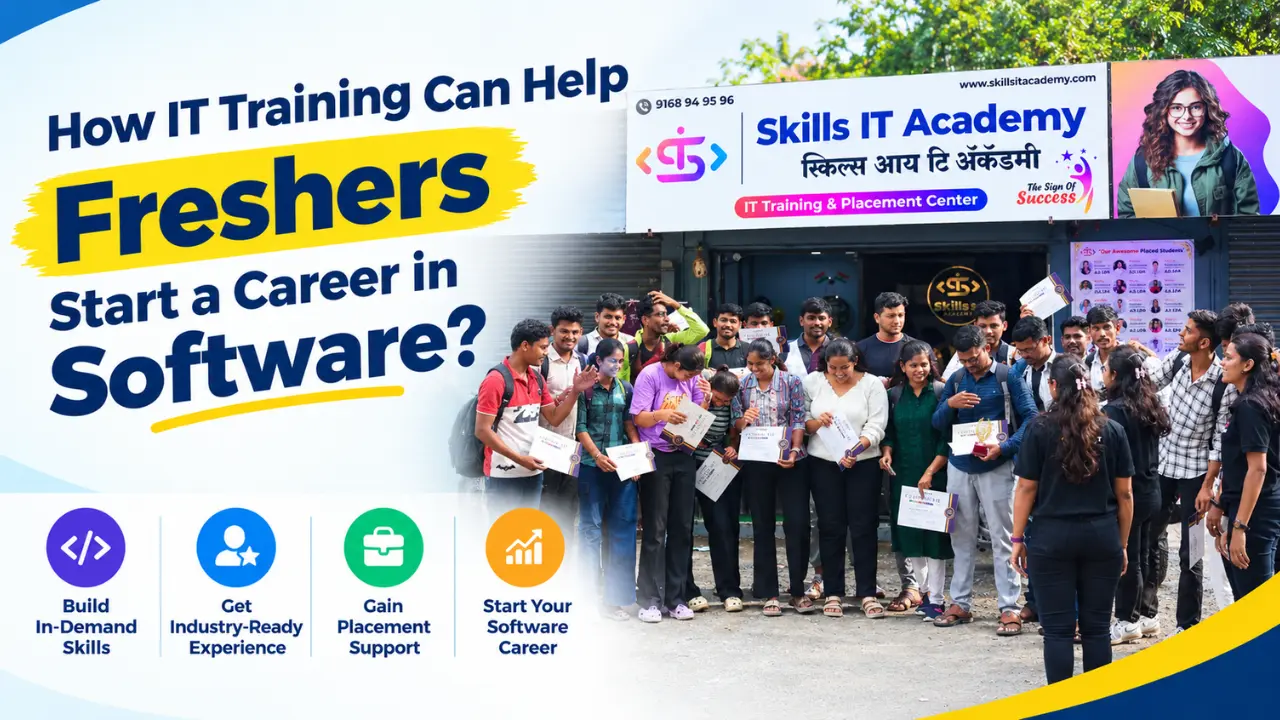
Starting a career in software can feel challenging for fresh graduates, especially when employers expect candidates to have practical skills along with a degree. Students may understand programming concepts academically but still feel unsure about writing code, building projects, using development tools, or preparing for technical interviews.
One of the questions many freshers ask before beginning their career journey is
How can IT training help me start a career in software?
For students looking for structured guidance, a software training institute in Pune can provide a learning environment where they can develop programming fundamentals, practical technical skills, project experience, and interview preparation.
The purpose of IT training is not simply to complete a course or receive a certificate. A well-structured training program can help freshers gradually move from learning basic concepts to applying those concepts through coding exercises, projects, debugging, and interview preparation.
The important question is therefore not only
“Which IT course should I join?”
It is also:
“Will the training help me develop the skills I need for an entry-level software role?”
Quick Answer: How Can IT Training Help Freshers Start a Software Career?
IT training can help freshers build a structured path toward an entry-level software career by combining technical learning with practical application.
Depending on the course, training may help students develop:
- Programming fundamentals
- Problem-solving skills
- Database knowledge
- Development skills
- Framework knowledge
- API understanding
- Git and GitHub experience
- Project development experience
- Debugging skills
- Technical communication
- Resume preparation
- Interview preparation
A fresher may already have a degree, but the transition from academic learning to software development often requires additional practical exposure.
A structured learning path can look like this:
Programming Fundamentals
↓
Core Technology
↓
Database
↓
Frameworks and Tools
↓
Practical Coding
↓
Projects
↓
Testing and Debugging
↓
Git/GitHub
↓
Resume Preparation
↓
Technical Interview Preparation
The exact learning path depends on the student's target role and chosen technology.
Why Do Freshers Find It Difficult to Start a Software Career?
Graduation and employment are two different stages of a career.
A student may complete a degree in engineering, computer applications, science, or another discipline without having enough practical exposure to software development.
Some common challenges include:
- Limited coding practice
- Difficulty choosing a technology
- Lack of project experience
- Weak programming fundamentals
- Limited understanding of databases
- Difficulty solving coding problems
- Lack of experience with development tools
- Uncertainty about software job roles
- Limited interview preparation
- Difficulty explaining projects
Academic Knowledge vs. Practical Skills
College education can provide theoretical foundations.
Software development, however, also requires students to apply those concepts.
For example, a student may understand what a database is but still need practical experience with:
- Creating tables
- Writing SQL queries
- Connecting applications with databases
- Retrieving data
- Updating records
- Handling errors
Similarly, knowing Java or Python syntax is different from developing an application using that technology.
This is where structured IT training can become useful.
1. IT Training Helps Freshers Build Programming Fundamentals
Programming is one of the foundations of many software development careers.
Before learning advanced frameworks, freshers need to understand basic programming concepts.
A structured programming course may cover:
- Variables
- Data types
- Operators
- Conditional statements
- Loops
- Functions or methods
- Arrays
- Strings
- Object-oriented programming
- Collections
- Exception handling
- Basic data structures
Why Are Programming Fundamentals Important?
Frameworks and tools change over time.
Programming fundamentals provide the foundation needed to understand how software works.
For example:
Problem
↓
Understand Requirements
↓
Design Logic
↓
Write Code
↓
Test
↓
Debug
↓
Improve
Freshers who regularly practice this process can gradually become more comfortable with programming problems.
2. IT Training Provides a Structured Learning Path
One of the difficulties freshers face is trying to learn everything at once.
They may jump between:
- Java
- Python
- JavaScript
- AI
- Cloud
- Data Science
- Cybersecurity
- Testing
This can create confusion.
A structured course can provide a defined learning sequence.
For example, a Java development learning path could be:
Java Fundamentals
↓
OOP
↓
Collections
↓
Exception Handling
↓
SQL
↓
JDBC
↓
Spring
↓
Spring Boot
↓
REST APIs
↓
Git/GitHub
↓
Projects
This gives the student a clear progression instead of learning unrelated technologies randomly.
3. Practical Coding Helps Freshers Move Beyond Theory
Reading programming concepts is different from writing programs.
A practical training program may include regular coding exercises such as
- Small programming problems
- Logic-building exercises
- Database queries
- API exercises
- Debugging tasks
- Application features
- Mini projects
Why Is Coding Practice Important?
When students write code repeatedly, they encounter real-world problems.
They may experience:
- Syntax errors
- Logic errors
- Database errors
- Incorrect outputs
- API errors
- Runtime errors
Learning how to identify and fix these problems is part of becoming comfortable with software development.
4. IT Training Can Help Freshers Understand Software Development Tools
Modern software development involves more than writing code.
Freshers may need exposure to tools used during development.
Depending on the course, these may include:
- Git
- GitHub
- IDEs
- Database tools
- API testing tools
- Build tools
- Testing frameworks
- Development frameworks
Why Should Freshers Learn These Tools?
A student who understands only programming syntax may still feel unfamiliar with the development workflow.
A broader learning process can be
Write Code
↓
Save Changes
↓
Use Version Control.
↓
Test
↓
Debug
↓
Commit Changes
↓
Push to Repository
This introduces students to the basic workflow surrounding software development.
5. Projects Give Freshers Practical Experience
Projects are one of the important components of job-oriented IT training.
A project gives students an opportunity to apply multiple concepts together.
For example, a beginner project could be:
Student Management System
The student may work with:
- Programming
- Database
- CRUD operations
- User input
- Validation
- Error handling
A more advanced project could involve:
E-commerce Application
The project may include:
- User registration
- Login
- Product management
- Database integration
- Shopping cart
- APIs
- Order management
- Testing
What Should Freshers Look for in a Project?
Students should ask:
- Will I build the project myself?
- Will the trainer explain the architecture?
- Will I write the code?
- Will I work with a database?
- Will I debug problems?
- Will my code be reviewed?
- Will I understand how the different components work?
Receiving a completed project is different from actually building one.
6. IT Training Helps Freshers Develop Problem-Solving Skills
Software companies do not only require candidates who can remember syntax.
Problem-solving is an important part of programming.
For example, a student may be asked to solve a problem involving:
Input
↓
Logic
↓
Processing
↓
Output
The student needs to understand the problem before writing the code.
Training can provide repeated opportunities to practice:
- Logical thinking
- Algorithmic thinking
- Debugging
- Breaking large problems into smaller tasks
- Finding coding errors
- Improving solutions
Why Does This Matter for Freshers?
A fresher may not know every technology before entering the industry.
However, having strong fundamentals and the ability to learn and solve problems can help them adapt to new technical requirements.
7. Training Can Help Freshers Choose a Software Career Path
The software industry contains many different career paths.
Freshers may consider roles such as:
- Java Developer
- Python Developer
- Full Stack Developer
- Software Tester
- Automation Tester
- Data Analyst
- Data Scientist
- Cloud Engineer
- DevOps Engineer
Each role requires a different skill set.
For example,
A software developer may focus on:
Programming + Frameworks + Databases + APIs + Projects
A tester may focus on:
Testing Concepts + Test Cases + SQL + API Testing + Automation
A data analyst may focus on:
Excel + SQL + Data Analysis + Visualization + Business Reporting
Therefore, students should first understand their career objective before selecting an IT course.
8. IT Training Can Connect Multiple Technical Skills
Software development rarely involves only one technology.
For example, a web application may involve:
Programming Language
↓
Database
↓
Backend
↓
API
↓
Frontend
↓
Version Control
↓
Testing
A structured program can help students understand how these components connect.
This is particularly useful for freshers because it gives them a broader understanding of the software development process.
9. IT Training Can Improve Debugging Skills
Debugging is an important part of programming.
Students often expect their first program to work perfectly.
In real development, errors are normal.
A program may produce:
- Compilation errors
- Runtime errors
- Incorrect results
- Database errors
- API errors
- Validation errors
Training can teach students to approach these problems systematically.
A Basic Debugging Process
Identify the Problem
↓
Read the error.
↓
Find the Relevant Code
↓
Understand the Cause
↓
Make a Change
↓
Test Again
↓
Verify the Result
This process can help freshers become more comfortable with software development.
10. Projects Can Help Freshers Build a Portfolio
A fresher often has limited professional experience.
Projects can provide evidence of practical learning.
A portfolio may include:
- Programming projects
- Web applications
- Database applications
- APIs
- Automation projects
- Data analysis dashboards
- GitHub repositories
What Should a Fresher Be Able to Explain?
During an interview, the student should ideally understand:
- Why the project was created
- What technologies were used
- How the database works
- What features were implemented
- What problems occurred
- How those problems were solved
- What the student personally contributed
The ability to explain a project is often more useful than simply mentioning its name on a resume.
11. IT Training Can Help With Resume Preparation
Technical knowledge is only one part of starting a career.
Freshers also need to present their skills clearly.
Training programs may provide guidance on:
- Resume structure
- Technical skills
- Project descriptions
- GitHub profile
- Certifications
- Academic projects
- Internship information
- Career objectives
What Should a Fresher's Resume Communicate?
A resume should make it easy to understand:
Education
↓
Technical Skills
↓
Projects
↓
Tools and Technologies
↓
Certifications
↓
Relevant Experience
The exact structure can vary depending on the student's background and target role.
12. Mock Interviews Can Prepare Freshers for Technical Discussions
Many freshers understand technical concepts but struggle to explain them during interviews.
Mock interviews can provide practice with questions such as
- What is OOP?
- What is inheritance?
- What is an exception?
- What is a database?
- What is SQL?
- What is an API?
- Explain your project.
- Why did you choose this technology?
- What problem did your project solve?
Why Practice Matters
A student may know the answer but struggle to communicate it clearly.
Repeated practice can help students become more familiar with technical discussions.
13. IT Training Can Improve Interview Readiness
Technical interviews may test different areas depending on the role.
A fresher may encounter questions related to:
- Programming
- OOP
- SQL
- Data structures
- Projects
- Frameworks
- Testing
- APIs
- Problem-solving
Interview preparation can help students understand what they know, what they need to improve, and how to explain their technical work.
14. Training Can Help Freshers Build a Consistent Learning Routine
One major benefit of structured training is consistency.
Instead of studying randomly, students can follow a routine such as
Daily Learning
↓
Concept
↓
Coding Practice
↓
Assignment
↓
Doubt Solving
↓
Project Work
↓
Revision
This can make the transition from academic learning to professional skill development more organized.
What Should Freshers Look for in an IT Training Program?
Before joining a course, freshers should examine more than the course name.
Consider the following:
Curriculum
- Does the syllabus match the target job?
- Are the fundamentals covered?
- Are current tools included?
- Is the course sufficiently practical?
Training
- How many training hours are included?
- Are classes live or recorded?
- Is doubt solving available?
- Can students interact with the trainer?
Practical Work
- Are coding exercises included?
- Are assignments evaluated?
- Is debugging taught?
- Are practical sessions included?
Projects
- How many projects are included?
- Will students build them from scratch?
- Is code reviewed?
- Are projects explained in detail?
Career Preparation
- Is resume guidance available?
- Are mock interviews included?
- Is technical interview preparation provided?
- What exactly does career assistance include?
What Is the Difference Between Learning Online and Joining Structured Training?
Freshers have several ways to learn software development.
They can use:
- Online courses
- YouTube tutorials
- Books
- Coding platforms
- Classroom training
- Live online training
- Self-study
Each approach has different learning requirements.
Self-Learning
Self-learning provides flexibility.
However, students need to manage:
- Learning schedule
- Course selection
- Practice
- Project selection
- Doubt solving
- Progress tracking
Structured Training
A structured program may provide:
- Defined syllabus
- Fixed schedule
- Trainer guidance
- Assignments
- Practical sessions
- Projects
- Assessments
- Interview preparation
The important question is not simply whether learning is online or offline.
The more useful comparison is:
Trainer Support + Practical Work + Projects + Learning Hours + Feedback + Career Preparation
How Much Time Should a Fresher Spend Learning IT Skills?
There is no single learning duration suitable for every student.
The required time can depend on:
- Previous programming knowledge
- Chosen technology
- Course depth
- Daily practice
- Project complexity
- Career objective
A student learning programming for the first time may require more practice than someone who already has coding experience.
A simple learning routine could be:
Concept Learning
↓
Practice
↓
Assignment
↓
Project Work
↓
Revision
Consistency is generally more useful than studying large amounts of material without practical application.
Common Mistakes Freshers Make When Starting a Software Career
Learning Too Many Technologies
Trying to learn five or six technologies simultaneously can create confusion.
It is often more practical to build a strong foundation in one career path before expanding.
Focusing Only on Certificates
A certificate can document course completion, but it does not replace practical skill.
Students should also focus on:
- Coding
- Projects
- Problem-solving
- Technical understanding
- Interview preparation
Copying Projects
A project copied from the internet may not help much if the student cannot explain how it works.
Build projects that you understand.
Ignoring SQL
Many software applications use databases.
Freshers targeting development roles should understand the database requirements of their chosen career path.
Avoiding Debugging
Errors are part of programming.
Students should learn how to investigate and solve them rather than avoiding difficult coding problems.
Waiting Until the End to Prepare for Interviews
Interview preparation can be introduced during the learning process rather than only after completing the course.
How Can Freshers Build a Software Career Step by Step?
A practical career-learning path can look like this:
Step 1: Understand Your Career Goal
Decide which type of software role interests you.
Step 2: Select a Suitable Technology
Choose a learning path based on the target role.
Step 3: Learn Programming Fundamentals
Build a strong foundation.
Step 4: Practice Regularly
Write code instead of only watching lectures.
Step 5: Learn Supporting Technologies
Depending on the role, this may include databases, frameworks, APIs, testing tools, or other technologies.
Step 6: Build Projects
Apply your knowledge to practical applications.
Step 7: Learn Development Tools
Understand Git, GitHub, IDEs, testing tools, and other relevant tools.
Step 8: Prepare Your Resume
Present your technical skills and projects clearly.
Step 9: Practice Interviews
Work on technical questions and project explanations.
Step 10: Continue Learning
Software technologies continue to change, so learning does not stop after completing a course.
How Can Skills IT Academy Help Freshers?
Students considering Skills IT Academy can evaluate the available programs based on the same practical criteria.
Before enrolling, students should check:
- Current course syllabus
- Course duration
- Training hours
- Technology coverage
- Practical sessions
- Projects
- Trainer details
- Batch structure
- Assessments
- Interview preparation
- Resume guidance
- Career assistance
The right course depends on the student's education, technical level, target role, schedule, and learning requirements.
Looking to Start a Software Career in Pune?
Freshers can explore relevant IT training programs, compare their curriculum and practical components, and select a learning path that matches their career objective.
The goal should not simply be to complete an IT course.
The goal should be to develop skills that can be demonstrated through coding, projects, technical discussions, and practical problem-solving.
Frequently Asked Questions About IT Training for Freshers
1. Can IT training help a fresher start a software career?
IT training can provide structured technical learning, practical coding, project experience, and interview preparation. The outcome depends on the student's effort, skills, learning consistency, and suitability for the target role.
2. Is IT training necessary for every fresher?
Not necessarily. Some students can develop software skills through self-learning, college projects, internships, or other experiences. Structured training can be useful for students who need a defined learning path and trainer guidance.
3. Which IT course is suitable for a fresher?
It depends on the student's career objective. Development, testing, data, cloud, and other software-related roles require different skills.
4. Can non-IT graduates learn software development?
Students from different educational backgrounds can learn software skills, although the learning path and preparation required may vary depending on their existing knowledge.
5. How long does it take to learn software development?
There is no fixed duration. It depends on the technology, course depth, previous knowledge, practice time, and project requirements.
6. Are projects important for freshers?
Projects can help freshers demonstrate practical knowledge and give them something concrete to discuss during interviews.
7. Does completing an IT course guarantee a software job?
No training course should be treated as an automatic guarantee of employment. Students should understand exactly what career or placement assistance an institute provides.
8. Should freshers learn one technology or multiple technologies?
A strong foundation in one relevant career path can be more manageable than trying to learn many unrelated technologies at the same time. Additional technologies can be added as the student's skills develop.
9. Is coding practice important for freshers?
Yes. Practical coding gives students experience applying concepts, solving problems, identifying errors, and developing solutions.
10. What should freshers check before joining an IT training program?
Freshers should check the syllabus, training hours, practical sessions, projects, trainer support, assessments, interview preparation, career assistance, total fee, and any additional charges.
Final Takeaway: How Can IT Training Help Freshers Start a Software Career?
Starting a software career requires more than completing a degree.
Freshers may need to develop:
Programming Fundamentals
↓
Technical Skills
↓
Practical Coding
↓
Problem-Solving
↓
Projects
↓
Development Tools
↓
Debugging Skills
↓
Resume Preparation
↓
Interview Preparation
A structured IT training program can help bring these areas together into a defined learning path.
However, training alone does not create a software career.
Students also need to practice consistently, understand what they learn, build projects, improve their problem-solving ability, and prepare for technical interviews.
Before joining any IT training program, compare:
Course Curriculum
↓
Training Hours
↓
Practical Learning
↓
Projects
↓
Trainer Support
↓
Tools and Technologies
↓
Interview Preparation
↓
Career Assistance
For freshers, the objective should be to move from learning concepts to applying skills and eventually being able to demonstrate those skills confidently in projects and interviews.