Software Training Institute vs Online IT Courses: Which Is Better?
Skills IT Academy Content Team
September 15, 2026
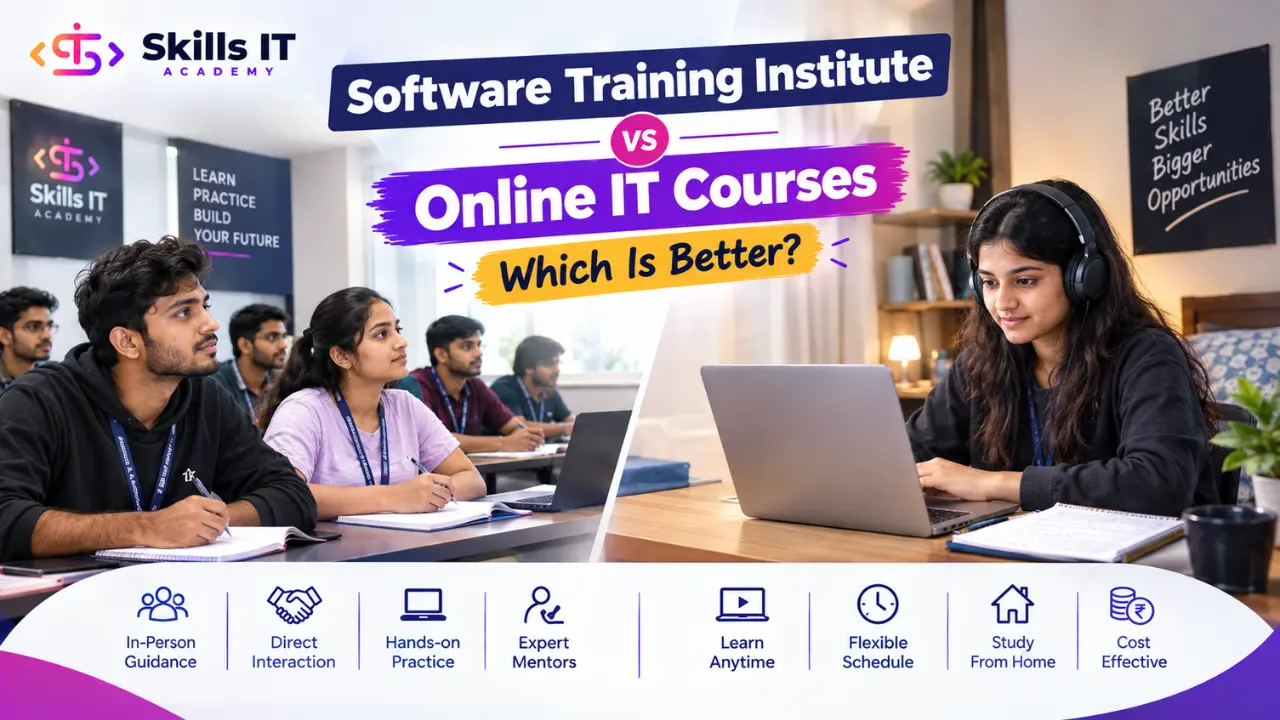
Choosing how to learn IT skills can be a difficult decision, especially for freshers and graduates planning to start a software career. Two common options are joining a software training institute or learning through online IT courses.
Both approaches can help students develop technical skills, but the learning experience, level of guidance, practical exposure, discipline, interaction, and career preparation can be completely unique.
So, Software Training Institute vs. Online IT Courses: Which Is Better?
The short answer is: neither option is automatically better for everyone. The right choice depends on your learning style, technical background, career goal, need for trainer support, practical learning requirements, and ability to study independently.
A software training institute in Pune can be a suitable option for students who require structured classroom learning, direct interaction with trainers, regular practice, doubt-solving, projects, and interview preparation.
Students who are comfortable learning independently, managing their own schedule, researching solutions, and consistently practicing without regular supervision may prefer online IT courses.
The most important point is that learning IT is not only about watching lessons or completing a syllabus. You need to understand concepts, practice technical skills, build projects, solve problems, debug applications, and prepare to explain your work during interviews.
This guide compares software training institutes and online IT courses to help freshers, graduates, working professionals, and career switchers make a more informed decision.
Quick Answer: Should you choose a software training institute or an online IT course?
If you want a direct comparison, consider your learning requirements first.
Choose a software training institute if you:
- Prefer classroom or instructor-led learning
- Need regular guidance
- Want to ask questions directly to a trainer
- Find it difficult to maintain self-discipline
- Want structured assignments and practice
- Prefer learning with other students
- Need support while working on projects
- Want mock interviews and career preparation
- Are starting IT from a basic or intermediate level
Choose an online IT course if you:
- Prefer flexible learning
- Need to study according to your schedule
- Are comfortable learning independently
- Already have basic technical knowledge
- Can consistently practice without supervision
- Prefer recorded lessons that can be replayed
- Want to learn from different instructors and platforms
- Need to combine learning with work or other responsibilities
For many freshers, a structured software training institute in Pune can make learning easier because the student receives a defined learning path and regular interaction with instructors.
However, online learning can also be highly effective when the learner has strong self-discipline and follows a practical learning process.
What Is a Software Training Institute?
A software training institute provides structured technical education through instructor-led classes, practical sessions, assignments, projects, and other learning activities.
Depending on the institute and course, students may learn technologies such as
- Java
- Python
- SQL
- Web development
- Full-stack development
- Software testing
- Automation testing
- Data analytics
- Data science
- Cloud computing
- DevOps
- Cybersecurity
- Artificial intelligence and machine learning
A good software training program should not simply focus on completing theoretical topics.
The learning process should ideally follow:
Learn → Practice → Build → Debug → Improve → Explain → Interview
This approach helps students move from understanding a concept to actually applying it.
What Are Online IT Courses?
Online IT courses allow students to learn technical subjects through the internet.
Online programs can include:
- Live online classes
- Recorded video courses
- Instructor-led sessions
- Self-paced courses
- Coding exercises
- Online assignments
- Projects
- Discussion forums
- Online assessments
One major advantage of online learning is flexibility.
A student can often study from home and choose when to complete lessons and practice.
However, flexibility also requires responsibility.
If a learner continuously postpones lessons, watches videos without practicing, or depends entirely on copied project solutions, completing an online course may not result in job-ready skills.
Software Training Institute vs. Online IT Courses: Major Differences
The biggest difference is not simply the location where learning happens.
The difference is often in structure, interaction, accountability, practical support, and learning environment.
1. Learning Environment
A software training institute generally provides a structured learning environment.
Students attend classes according to a schedule and follow a defined curriculum.
Online courses provide greater flexibility. Students can learn from home or another location and may have more control over their schedule.
Best for structured learning: Software training institute
Best for flexible learning: Online IT course
2. Trainer Interaction
Trainer interaction can be important when learning programming or technical concepts.
In classroom training, students can generally ask questions during or immediately after the session.
Depending on the online course, students may have live trainer interaction, discussion forums, email support, or limited doubt-solving.
Therefore, online learning quality can vary significantly between courses.
Best for direct interaction: Classroom software training
Best for independent learners: Online learning
3. Doubt Solving
Programming students often face errors that are difficult to understand from a video alone.
For example, a student may understand how to write Java code but struggle when an application produces an unexpected error.
Direct guidance can help the student understand:
- What caused the error?
- How to identify the problem
- How to debug the code
- How to improve the implementation
A strong online course can also provide doubt-solving, but students should check exactly how that support works before enrolling.
4. Practical Learning
Practical training is essential for software careers.
Students should not only know what technology is. They should know how to use it.
For example, a Java learner may need to practice:
- Object-oriented programming
- SQL
- Database connectivity
- APIs
- Backend development
- Frameworks
- Git and GitHub
- Application development
- Debugging
Similarly, a software testing student may need practical exposure to:
- Test cases
- Test scenarios
- Bug reporting
- Functional testing
- API testing
- Automation testing
- Selenium
- Testing frameworks
The quality of practical learning depends more on the course design than whether the course is online or offline.
5. Discipline and Accountability
This is one of the biggest differences between the two learning methods.
Classroom training creates a fixed schedule.
You have a specific class time, trainer, batch, assignments, and learning environment.
Online learning gives you more freedom.
That freedom is useful for disciplined learners but can become a challenge for students who frequently postpone their learning.
Ask yourself:
Can I study consistently without someone reminding me?
If the answer is no, structured classroom training may be more suitable.
6. Peer Learning
Classroom training allows students to learn alongside other students.
This can create opportunities to:
- Discuss programming problems
- Compare approaches
- Work on assignments
- Share ideas
- Practice communication
- Participate in group activities
- Learn from other students' questions
Online communities can also provide peer interaction, but the experience depends on the platform and course.
7. Projects
Projects are important for both classroom and online learning.
A student should not simply add a project name to a resume.
They should understand:
- What the project does
- Why specific technologies were selected
- How the application works
- How the database was designed
- How APIs were implemented
- What problems occurred
- How bugs were solved
- What improvements could be made
Whether you learn online or offline, project understanding matters more than simply completing a project.
Is Classroom IT Training Better for Freshers?
For many freshers, classroom training can be useful because they are still developing their technical learning habits.
A fresher may need help understanding:
- Programming fundamentals
- Problem-solving
- SQL
- Debugging
- Project development
- Git and GitHub
- Technical terminology
- Interview questions
- Resume presentation
- Communication
A structured environment can help students maintain consistency.
However, classroom training does not automatically guarantee better results.
The student still needs to practice outside class and take responsibility for their learning.
Is Online IT Learning Better for Working Professionals?
Online learning can be convenient for working professionals because they may have limited availability during regular classroom hours.
For example, a professional may prefer to study:
- Early morning
- During weekends
- After work
- During personal free time
Online courses can provide the flexibility required to fit learning around an existing schedule.
However, working professionals should still evaluate whether the course includes practical assignments, projects, trainer support, and sufficient technical depth.
Which Is Better for Students With No Coding Experience?
Students with no coding experience often need more guidance.
Programming concepts such as variables, loops, functions, classes, objects, databases, APIs, and debugging can initially be difficult.
For such students, a structured learning environment can be helpful.
A suitable learning path may look like this:
Computer Fundamentals → Programming Fundamentals → Problem Solving → SQL → Framework → Projects → Interview Preparation
Students choosing online learning should make sure the course starts from their actual skill level rather than assuming previous programming knowledge.
Which Is Better for Students Who Already Know Programming?
Students who already understand programming may benefit from online learning if they can identify exactly what they need to learn.
For example, someone who knows Core Java may want to learn:
Spring → Spring Boot → REST APIs → Database Integration → React → Full-Stack Projects
Such learners may not need beginner-level classroom instruction.
However, if they have difficulty implementing projects or debugging applications, instructor support can still be valuable.
Software Training Institute vs. Online IT Courses for Job Preparation
Learning technical concepts and becoming interview-ready are not exactly the same thing.
A job-oriented learning process should include:
Technical Knowledge + Practical Skills + Projects + Problem Solving + Communication + Interview Preparation
When comparing a software training institute and an online course, check whether the program includes:
- Coding practice
- Assignments
- Projects
- Debugging
- SQL
- Git and GitHub
- Resume preparation
- Mock interviews
- Technical interview preparation
- Project explanation practice
- Career guidance
Do not assume that every course includes these components.
Always verify what is actually provided.
Does an Online Certificate Help Get an IT Job?
A certificate can demonstrate that a learner completed a course, but a certificate alone does not prove job readiness.
Employers may evaluate practical abilities such as
- Programming
- Technical fundamentals
- Problem-solving
- SQL
- Projects
- Debugging
- Communication
- Technical interview performance
Therefore, students should avoid selecting an online course only because it offers a certificate.
The same principle applies to classroom training.
A classroom certificate is not a replacement for practical skills either.
Which Option Is More Cost-Effective?
Cost should not be evaluated only by comparing course fees.
Consider the overall value of the learning experience.
For example:
Course fee + practical training + trainer support + projects + assignments + interview preparation + learning resources
An inexpensive course may not provide sufficient practical support.
Similarly, a more expensive course is not automatically better.
Before enrolling, compare what you actually receive.
Software Training Institute vs Online IT Courses: Which Is Better for Projects?
Both can be effective.
The important question is
Will you actually build and understand projects?
For example, a full-stack student could build:
- E-commerce application
- Job portal
- Employee management system
- Inventory management application
- Banking application
A project should involve actual development rather than simply copying code from a tutorial.
Students should be able to explain their implementation during interviews.
Which Is Better for Learning Programming?
Programming requires repeated practice.
Watching a programming lesson is not the same as writing code.
A learner should follow:
Watch → Understand → Code → Make Errors → Debug → Improve → Repeat
Students who need regular accountability may benefit from classroom training.
Students who already have strong discipline may successfully learn programming online.
Therefore, the best option depends on the learner rather than the delivery format alone.
Which Is Better for Software Testing?
Both classroom and online courses can teach software testing.
A practical testing learning path may include:
Testing Fundamentals → Test Cases → Test Scenarios → Bug Reporting → Functional Testing → API Testing → Automation Testing → Selenium → Testing Frameworks → Projects
Students should compare whether the course provides hands-on practice rather than only theoretical definitions.
If you prefer direct guidance while learning testing tools, classroom training may be useful.
If you are comfortable practicing independently, an online course may also work.
Which Is Better for Full-Stack Development?
Full-stack development involves multiple technologies.
For example, a Java full-stack learning path may include:
Core Java → OOP → SQL → HTML → CSS → JavaScript → React → Spring → Spring Boot → REST APIs → Hibernate/JPA → Git/GitHub → Projects
Because the learning path is broad, beginners may benefit from structured instruction and trainer support.
However, independent learners can also follow an online full-stack curriculum successfully if they consistently practice and build projects.
Which Is Better for Students in Pune?
For students specifically looking for IT training in Pune, the choice should depend on their learning preferences and career goals.
Pune has a large student and technology-training ecosystem, so students can compare different training formats before making a decision.
If you are searching for a software training institute in Pune, do not select an institute only because it appears high in advertisements or has attractive claims.
Evaluate:
- Curriculum
- Trainer experience
- Practical sessions
- Course duration
- Projects
- Assignments
- Git and GitHub
- Interview preparation
- Placement assistance
- Reviews
- Batch size
- Demo class
- Fees
- Learning support
The same evaluation should be applied when choosing an online IT course.
What Should You Check Before Joining a Software Training Institute?
Before enrolling, ask the institute:
Curriculum
Does the curriculum cover the skills required for the target job role?
Trainer
Who will actually teach your batch?
Practical Training
How much time is dedicated to coding, tools, and hands-on work?
Projects
How many projects will you build?
Project Support
Will the trainer review and provide feedback on your project?
Interview Preparation
Are mock interviews and technical interview sessions included?
Placement Assistance
What exactly does placement assistance mean?
It may include resume support, interview opportunities, referrals, mock interviews, or career guidance.
Ask for specific details instead of assuming that "placement assistance" means guaranteed employment.
Demo Class
Attend a demo class whenever possible.
This allows you to evaluate the teaching style and determine whether the explanation is suitable for your learning level.
What Should You Check Before Buying an Online IT Course?
Before purchasing an online course, check:
- Who is the instructor?
- Is the content updated?
- Is the course beginner-friendly?
- Are practical assignments included?
- Are coding exercises included?
- Are projects included?
- Is doubt-solving available?
- Is live support available?
- Can you ask questions?
- Are projects reviewed?
- Are interview resources provided?
- How long do you have access to the course?
- Are there additional costs?
- Are lessons self-paced or live?
Do not purchase a course simply because it has thousands of students or a high rating.
The course should match your career goal and learning level.
Advantages of a Software Training Institute
A structured software training institute can offer several potential benefits.
Structured Learning
You follow a defined curriculum instead of deciding what to learn next.
Direct Trainer Interaction
You can ask questions and receive guidance during your learning journey.
Regular Practice
Assignments and classroom exercises can encourage consistent practice.
Learning Environment
Studying alongside other students can create a more structured atmosphere.
Project Guidance
Trainer support can help when students face difficulties during project development.
Interview Preparation
Some institutes include mock interviews, resume support, and technical interview preparation.
The actual experience depends on the institute, so students should verify these features before enrolling.
Advantages of Online IT Courses
Online learning also has important advantages.
Flexibility
You can learn according to your schedule.
Location Independence
You can study without travelling to a physical institute.
Replayable Content
Recorded lessons can often be watched multiple times.
Learning Speed
You can pause, rewind, or accelerate lessons depending on your understanding.
Wide Course Selection
Online platforms may provide courses across many technologies and specializations.
Convenience
Students can combine learning with work, college, or other responsibilities.
Disadvantages of Classroom Training
Classroom training also has limitations.
- Fixed schedules
- Travel time
- Physical attendance
- Batch-dependent pace
- Quality depends on the trainer and institute.
- Course fees may be higher than some online alternatives.
Therefore, students should evaluate the actual learning value instead of assuming classroom training is always superior.
Disadvantages of Online IT Courses
Online learning can create challenges for some students.
- Lack of regular supervision
- Self-discipline required
- Possible difficulty getting immediate answers
- Easy to postpone lessons
- Too much dependence on videos
- Difficulty maintaining consistency
- Limited project feedback in some courses
These disadvantages do not mean online learning is ineffective.
They mean that online learning works best when the learner is capable of taking responsibility for the learning process.
A Simple Decision Guide
Ask yourself these questions:
Do I need a fixed learning schedule?
If yes, consider classroom training.
Do I need frequent trainer interaction?
If yes, a software training institute may be suitable.
Can I learn independently?
If yes, online learning may work well.
Do I have a full-time job?
If yes, online or flexible live training may be convenient.
Am I completely new to programming?
If yes, structured guidance may be beneficial.
Do I already have strong technical fundamentals?
If yes, self-paced online specialization may be sufficient.
Do I need project and interview guidance?
Compare the actual support provided by both options before choosing.
Software Training Institute vs Online IT Courses: Which Is Better for Freshers?
For a fresher, the decision should not be based only on classroom versus online.
The more important question is
Which learning format will help you consistently develop job-ready skills?
If you need guidance, accountability, practical support, and regular interaction, classroom training may be a strong choice.
If you are disciplined, comfortable researching problems, and capable of following a learning roadmap independently, online learning may work well.
For many freshers, a combination can also be useful:
Classroom/Live Training + Online Practice + Projects + Self-Learning
The classroom or live instructor provides structure, while online resources can be used for additional practice and revision.
Common Mistakes When Choosing Between Online and Offline IT Training
Avoid choosing an option only because:
- It is cheaper.
- It is more popular.
- It offers a certificate.
- An advertisement promises a job
- Someone on social media recommended it.
- Your friends selected it.
- It claims extremely high salaries.
- It has a large number of recorded videos.
Instead, ask:
What skills will I actually develop?
How much practical work will I do?
Will I build projects?
Can I get my doubts solved?
Will I receive feedback?
Will I be prepared to explain my skills in an interview?
These questions are more useful than simply comparing course formats.
Is Blended Learning Better Than Online or Classroom Training?
For some learners, blended learning can combine the strengths of both approaches.
A blended model can involve:
Instructor-Led Training + Online Resources + Self-Practice + Projects + Mock Interviews
For example, a student could attend structured classes to understand concepts and use online resources to revise difficult topics.
This can provide flexibility while maintaining a structured learning path.
However, blended learning is effective only when students actually practice and apply what they learn.
How Skills IT Academy Can Support Your IT Learning Journey
Students comparing a software training institute in Pune can evaluate Skills IT Academy based on their preferred career path, technical background, learning requirements, and course curriculum.
Skills IT Academy focuses on technology-oriented learning across areas such as programming, software development, software testing, data, cloud, DevOps, cybersecurity, artificial intelligence, and related IT skills.
For students who prefer structured training, practical learning, trainer interaction, projects, and career preparation, an instructor-led learning environment can provide a useful framework.
Before joining any program, students should review the current curriculum, understand the practical components, attend a demo class when available, and determine whether the course matches their career objective.
The goal should not simply be to complete a course.
The goal should be
Learn → Practice → Build → Debug → Improve → Explain → Interview
Students who consistently follow this process can develop a stronger foundation for entering the IT industry.
Frequently Asked Questions
Is a software training institute better than an online IT course?
Not necessarily. Both can be effective. A software training institute may be better for students who need structured learning, direct trainer interaction, regular practice, and guidance. Online courses may be better for disciplined learners who need flexibility and can study independently.
Which is better for freshers, online or classroom IT training?
Freshers who need regular guidance and accountability may benefit from classroom training. Students who are comfortable learning independently may prefer online courses.
Is online IT training enough to get a software job?
An online course can help develop technical knowledge, but completing a course alone does not guarantee employment. Students also need practical skills, projects, problem-solving ability, communication, and interview preparation.
Is classroom training necessary for learning programming?
No. Programming can be learned online or offline. The key requirements are understanding concepts, writing code regularly, solving problems, debugging errors, and building projects.
Which is better for Java, online or classroom training?
Both can work. Beginners who need structured guidance may prefer classroom Java training, while experienced or disciplined learners may successfully learn Java online.
Which is better for Python, online or classroom training?
Both options can work depending on the learner. Python beginners may benefit from structured instruction, while independent learners may prefer the flexibility of online courses.
Can I learn full-stack development online?
Yes. Full-stack development can be learned online, but students need significant hands-on practice. They should build projects and understand frontend, backend, database, APIs, version control, and deployment concepts relevant to their chosen technology stack.
Are online certificates valuable for freshers?
Certificates can demonstrate course completion, but they do not replace practical skills. Freshers should focus on technical knowledge, projects, problem-solving, and interview preparation.
Should I join a software training institute in Pune after graduation?
It can be considered if you want structured IT training, practical guidance, trainer interaction, projects, and career preparation. Before joining, compare the curriculum, trainer, projects, practical sessions, fees, reviews, and placement assistance.
What should I check before joining an IT training institute?
Check the curriculum, trainer experience, practical training, assignments, projects, Git and GitHub training, interview preparation, placement assistance, batch size, reviews, demo class, fees, and learning support.
What should I check before buying an online IT course?
Check the instructor, curriculum, practical assignments, projects, doubt-solving support, course access period, updated content, reviews, project feedback, and interview resources.
Can online courses and classroom training be used together?
Yes. Students can use classroom or live training for structured learning and online resources for revision, additional practice, and self-learning.
Which learning method is best for a non-IT graduate?
A non-IT graduate may benefit from a structured learning path that starts with computer and programming fundamentals before moving into advanced technologies. Classroom training can provide additional guidance, but online learning is also possible with consistent effort.
Final Verdict: Software Training Institute vs. Online IT Courses
So, Software Training Institute vs. Online IT Courses: Which Is Better?
There is no universal answer.
A software training institute can be a better fit if you need:
Structure + Trainer Guidance + Practical Learning + Accountability + Project Support
An online IT course can be a better fit if you need:
Flexibility + Convenience + Self-Paced Learning + Independent Study
For freshers, the decision should depend on how much guidance they need and how effectively they can learn independently.
The most important factor is not whether the course is online or offline.
It is whether the learning process helps you:
Understand → Practice → Build → Debug → Improve → Explain → Interview
Before choosing a software training institute in Pune or an online IT course, identify your target job role, compare the curriculum, check the practical training, understand the project requirements, evaluate trainer support, and verify what career assistance is actually provided.
Your objective should not be simply to finish an IT course.
Your objective should be to develop skills that you can demonstrate, explain, and apply in a real software environment.