Still Jobless After a Coding Course? Here’s What Nobody Told You
Skills IT Academy Content Team
October 17, 2026
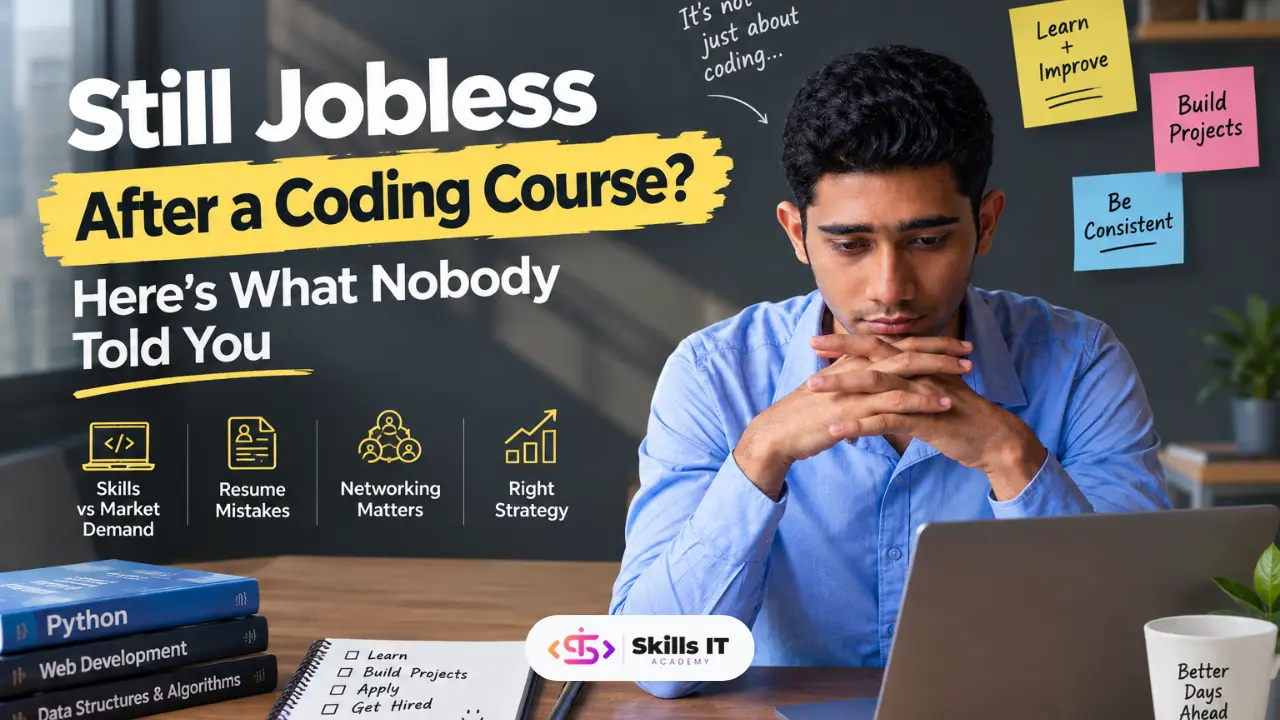
Completing a coding course is an important step toward building a career in IT. But what happens when you finish the course, receive a certificate, update your resume, and still struggle to get a job?
For many freshers and career switchers, this situation can be frustrating. You may have learned Java, Python, software testing, web development, cloud computing, or another technical skill, yet job opportunities remain limited.
The truth is that completing a coding course and becoming job-ready are two different things.
Employers often look beyond certificates. They may evaluate your practical knowledge, problem-solving ability, project experience, communication skills, technical interview performance, and understanding of real-world development.
If you are still searching for an IT job after completing your training, it does not automatically mean you chose the wrong course or cannot build a successful career in technology.
It may mean that some important parts of your job preparation need improvement.
In this guide, we will explore why candidates remain unemployed after coding courses, the mistakes that can affect their job search, and the practical steps you can take to improve your chances of getting hired.
Why Are You Still Jobless After Completing a Coding Course?
There is no single reason why candidates struggle to find employment after technical training.
Your results may depend on your skills, course quality, project experience, interview preparation, job-search strategy, qualifications, and the opportunities available in the market.
Let's look at the most common challenges.
1. You Learned the Concepts but Did Not Practice Enough
Watching lectures and understanding programming concepts can help you build a foundation. However, professional software development requires more than remembering definitions.
Can you write code without following a tutorial? Can you identify a bug? Can you explain why your solution works? Can you solve a problem when the question is unfamiliar?
These are the types of abilities you should develop during training.
What you should do:
- Practice coding regularly.
- Solve programming problems independently.
- Rebuild examples without copying the original code.
- Debug errors instead of immediately searching for solutions.
- Explain your code in your own words.
Consistent practice can help turn theoretical knowledge into practical ability.
2. You Completed the Course but Have No Strong Projects
A certificate may show that you completed a training program, but a practical project can help demonstrate what you know.
For example, a Java learner could build an employee management system or an e-commerce backend. A Python learner might develop a data-processing application. A software testing candidate could prepare test cases and automation scripts for a suitable application.
The important point is not simply having projects listed on your resume. You should understand how they work.
What you should do:
Build two or three meaningful projects that match your target role. Be prepared to explain the problem, technologies, implementation, database design, testing, challenges, and improvements.
3. Your Resume Does Not Demonstrate Your Skills
Your resume is often one of the first ways a recruiter evaluates your suitability for a position.
A resume that lists programming languages without showing practical experience may not communicate your abilities effectively.
Common resume problems include:
- Listing skills you cannot confidently explain.
- Describing projects without explaining your contribution.
- Using a generic resume for every job.
- Including irrelevant information.
- Missing project links or a GitHub portfolio where appropriate.
- Making spelling, formatting, or contact-detail errors.
What you should do:
Create a clear, role-specific resume. Highlight relevant technical skills, projects, tools, practical achievements, and your actual contribution to each project. Include measurable results only when you can substantiate them.
4. You Are Applying for Jobs Without Matching the Requirements
Many candidates apply to numerous positions without checking whether their skills match the job description.
For example, a candidate who knows only basic Java may struggle to qualify for a position requiring production experience with Spring Boot, microservices, databases, testing, and cloud platforms.
This does not mean you must know every technology before applying. It means you should understand the difference between entry-level requirements and advanced role requirements.
What you should do:
- Identify your target job title.
- Read job descriptions carefully.
- Separate essential skills from desirable skills.
- Compare the requirements with your current abilities.
- Apply to suitable fresher and junior positions.
- Build missing skills based on recurring job requirements.
A focused job search can be more productive than applying randomly.
5. You Have Not Prepared Properly for Technical Interviews
Understanding a topic while studying is different from explaining it during an interview.
A candidate may understand object-oriented programming but struggle to explain inheritance, polymorphism, encapsulation, and abstraction with practical examples.
Similarly, a software testing candidate may know testing terminology but find it difficult to write test cases or explain defect life cycles.
What you should do:
Practise technical questions, coding exercises, project explanations, and mock interviews. Learn to explain concepts clearly instead of memorising answers word for word.
Interview preparation should be part of your learning process, not something you begin only after receiving an interview invitation.
The Truth Nobody Told You About Coding Courses
A coding course can provide structure, guidance, and opportunities to practice. However, it cannot automatically guarantee that you will be hired.
Here are some realities every aspiring IT professional should understand.
A Certificate Is Not the Same as Job Readiness
A certificate documents course completion. It does not necessarily demonstrate independent coding ability, debugging skills, project ownership, or readiness for a specific position.
Use your certificate as supporting evidence, while building practical skills that you can demonstrate.
Knowing Many Technologies Is Not Always Better
Learning Java, Python, React, cloud computing, data science, and software testing simultaneously may leave you with limited practical knowledge of each.
Instead, choose a primary career path and develop the skills required for that role.
For example, an aspiring Java backend developer could focus on Core Java, SQL, Spring Boot, REST APIs, Git, testing, and practical projects.
Your First Job May Require Patience and Consistent Effort
Job-search timelines vary. Some candidates find opportunities quickly, while others need more time to strengthen their skills, improve their resumes, or prepare for interviews.
Rejection does not automatically mean you are unsuitable for the IT industry. Use feedback where available to identify what needs improvement.
Placement Assistance and Guaranteed Employment Are Not the Same
Before joining a training institute, understand exactly what its placement support includes.
Ask about interview opportunities, resume guidance, mock interviews, employer connections, eligibility criteria, and the conditions attached to any placement claims.
Evaluate the actual services offered rather than relying only on promotional promises.
What Skills Do Employers Look for Beyond Coding?
Requirements differ across companies and job roles, but several capabilities are useful for aspiring software professionals.
Technical Fundamentals
Develop a strong understanding of the concepts relevant to your chosen role.
For Java development, this may include Core Java, object-oriented programming, collections, exception handling, SQL, and Spring Boot.
For software testing, it may include test design, defect reporting, SQL, API testing, and relevant automation tools.
Problem-Solving Ability
Practise breaking complex problems into smaller steps, evaluating possible solutions, and identifying errors.
You do not need to know every answer immediately, but you should learn how to approach unfamiliar problems systematically.
Practical Project Experience
Build projects that demonstrate your ability to apply what you have learned.
Ensure that you can explain your own implementation and answer questions about your technical decisions.
Version Control and Development Tools
Depending on your target role, learn tools such as Git and GitHub, integrated development environments, API testing tools, debugging tools, and relevant testing frameworks.
Communication Skills
You should be able to explain your work, ask questions, discuss challenges, and describe your reasoning.
Clear communication can help interviewers understand your technical knowledge.
A Practical 30-Day Plan to Improve Your Job Readiness
If you have completed a coding course but are still searching for work, use the next 30 days to identify gaps and build evidence of your skills.
Week 1: Review Your Fundamentals
Revisit the most important concepts in your chosen technology.
Practise coding or role-specific exercises daily. Identify topics you cannot explain or apply independently.
Week 2: Build or Improve a Project
Create a small but complete project relevant to your target role.
Focus on understanding the implementation, handling errors, testing the result, and documenting the work.
Week 3: Improve Your Resume and Interview Preparation
Update your resume to highlight relevant skills and projects.
Practise technical questions, solve suitable problems, and complete mock interviews. Review any feedback from previous interviews to identify recurring weaknesses.
Week 4: Follow a Focused Job-Search Strategy
Identify suitable entry-level vacancies and tailor your applications to the requirements.
Use professional networking platforms, company career pages, referrals, and legitimate job portals. Track applications and follow up appropriately.
At the end of the month, review your progress. If you are not receiving interviews, reassess your resume, skills match, and application strategy. If you are receiving interviews but not progressing, focus on interview performance and technical gaps.
This plan is a practical starting point, not a guarantee of employment within 30 days.
Which IT Career Path Should You Choose After a Coding Course?
Your next step should depend on your interests, current skills, educational background, and target role.
Possible career paths include:
Java Development: Core Java, SQL, Spring Boot, REST APIs, Git, testing, and backend projects.
Python Development: Python fundamentals, data structures, APIs, databases, testing, and projects suited to the target role.
Software Testing: Manual testing, test cases, defect reporting, SQL, API testing, and automation tools where required.
Full-Stack Development: Frontend fundamentals, a suitable JavaScript framework, backend development, databases, APIs, and project integration.
Cloud Computing: Cloud fundamentals, networking, operating systems, deployment, security basics, and hands-on cloud projects.
Avoid choosing a path only because someone claims it offers the highest salary. Select one that matches your interests and that you are prepared to practice consistently.
How to Choose the Right IT Training Institute in Pune
If you are considering additional training, do not automatically enroll in another course without identifying why your first attempt did not lead to employment.
Before selecting a software training institute in Pune, evaluate:
- Whether the curriculum matches current entry-level job requirements.
- Whether training includes practical exercises and independent coding.
- Whether students build projects from scratch.
- Whether trainers provide feedback on assignments and code.
- Whether mock interviews and resume guidance are available.
- Whether placement support is clearly explained.
- Whether the advertised outcomes are supported by verifiable evidence.
Skills IT Academy provides a starting point for students exploring IT training options in Pune. Review the relevant course syllabus and verify the current training, project, interview preparation, and career-support services before enrolling.
You can explore the Skills IT Academy website and its Java Full Stack Development course if Java development aligns with your career goal.
The objective should be to select training that addresses your actual skill gaps rather than repeatedly collecting certificates.
Frequently Asked Questions
Why am I not getting a job after completing a coding course?
Possible reasons include limited practical experience, weak projects, a generic resume, insufficient interview preparation, or applying for positions that do not match your skills. Review your application and interview results to identify the most likely gaps.
Is a coding certificate enough to get an IT job?
A certificate alone may not be enough. Employers can also evaluate technical knowledge, practical projects, problem-solving ability, communication, qualifications, and interview performance.
How can I get an IT job as a fresher with no experience?
Build relevant projects, practice technical questions, create a role-specific resume, develop a portfolio where appropriate, and apply for suitable entry-level positions. Be ready to explain your projects and technical decisions.
Should I join another coding course if I am still unemployed?
First identify what is missing from your current preparation. Another course may help if you need structured instruction or practical guidance, but repeating similar training without addressing your skill gaps may not solve the problem.
How many projects should a fresher have?
There is no fixed number. Start with two or three well-developed projects that are relevant to your target role and that you can explain confidently.
Does placement assistance guarantee a job?
No. Placement assistance and employment guarantees are different. Review the institute's written terms and verify the specific services and conditions offered.
Final Takeaway
Still being jobless after a coding course can be discouraging, but it does not automatically mean your IT career is over.
The next step is to identify what is preventing you from progressing and take action based on evidence.
Strengthen your fundamentals. Build practical projects. Improve your resume. Practise interviews. Apply for suitable roles. Learn from rejection and continue improving your technical abilities.
Do not focus only on completing another course. Focus on demonstrating that you can apply your skills to real problems.
If you are exploring IT training in Pune, choose a learning path that supports your career goals and provides the practical preparation you need.
Your certificate may be the starting point. Your skills, projects, problem-solving ability, and consistent effort are what you need to keep developing as you pursue your first IT job.